Joseph Pieper says in his book Enthusiasm and Divine Madness, on the Phaedrus of Plato,
The very great teachers do not write. Few will guess that this . . . sentence is an almost literal quotation from the Summa theologica of Thomas Aquinas, who specifically mentions Socrates in connection with this statement. Thomas asks whether Christ should not have set down his doctrine in writing -- and answers that the higher mode of teaching is proper to the greater teacher, and that that higher mode consists in impressing his doctrine upon the hearts of his hearers. (101)
Thursday, July 27, 2006


Monday, July 10, 2006
Zidane?

Everyone wants to know what was said.
Of course, the King's ignominous act cannot be forgotten either, but in the case of Cantona, he seemed to learn something from his suspension and found some redemption when he returned to play. What is Zidane to learn from this, for he will never return to play?
Wednesday, July 05, 2006
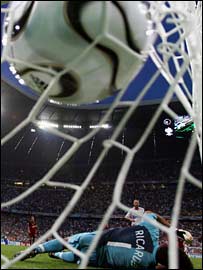
Zidane!

I'll always be partial to the King, but Zidane is my new French soccer hero. He even has a flashy Web page.

UPDATE: a great picture of Zidane's penalty kick against Portugal.
Friday, June 30, 2006
On Rhetoric
For the record, Fonseca Bin no. 27 is my favorite annual port (meaning it is produced every year and so is widely available ... truly high quality sweet wines are only produced when the grapes are just right and so are unpredictable).
A good friend thoughtfully gave me the Loeb with Plato's Symposium, Lysis and Gorgias for summer reading, and I have decided to work through Gorgias. If I keep an average pace of about 15 pages per week I should easily finish during the summer. I'll post comments here to keep myself accountable (cough).
As an opener: So far, Mr. W.R.M. Lamb ("sometime fellow of Trinity College, Cambridge") seems to have been an ironic choice to translate the dialogue on rhetoric, for his translation robs the speakers of some of their best demonstrations of wit. This is so important because Gorgias is the supreme rhetorician whose craft, as Socrates will demonstrate, has nothing to do with true knowledge and so is not a craft at all; besides, as we shall see, Socrates is better at it than everyone else.
Very Beginning (my own):
Kallikles: As they say, Socrates, you desire a war and battle so as to get a share (ie., just to get the spoils).
Socrates: Rather do you mean the saying, we have come too late for the feast?
K: Indeed and a most urbane feast. For just a moment ago Gorgias put on a varied and beautiful display for us.
S: Chaipheron here is to blame, having forced us to spend our time in the market place.
Get it? Kallikles has just listened to a display of rhetoric, but has learned nothing (because rhetoric has nothing true to teach) since he immediately proceeds to quote a useless proverb at his new quests. Kallikles calls the feast urbane; Socrates puns on the word complaining that he was stuck in the market (ie., the center of the city). Who's the rhetorician now? Who's the true teacher: the one at a feast giving a self congratulatory display of words at a posh dinner or the one in the market place with his students? Ta da, the themes of the dialogue summarized and proven in the first four lines. All of this is missed in Lamb's translation thanks to his unimaginative diction.
A good friend thoughtfully gave me the Loeb with Plato's Symposium, Lysis and Gorgias for summer reading, and I have decided to work through Gorgias. If I keep an average pace of about 15 pages per week I should easily finish during the summer. I'll post comments here to keep myself accountable (cough).
As an opener: So far, Mr. W.R.M. Lamb ("sometime fellow of Trinity College, Cambridge") seems to have been an ironic choice to translate the dialogue on rhetoric, for his translation robs the speakers of some of their best demonstrations of wit. This is so important because Gorgias is the supreme rhetorician whose craft, as Socrates will demonstrate, has nothing to do with true knowledge and so is not a craft at all; besides, as we shall see, Socrates is better at it than everyone else.
Very Beginning (my own):
Kallikles: As they say, Socrates, you desire a war and battle so as to get a share (ie., just to get the spoils).
Socrates: Rather do you mean the saying, we have come too late for the feast?
K: Indeed and a most urbane feast. For just a moment ago Gorgias put on a varied and beautiful display for us.
S: Chaipheron here is to blame, having forced us to spend our time in the market place.
Get it? Kallikles has just listened to a display of rhetoric, but has learned nothing (because rhetoric has nothing true to teach) since he immediately proceeds to quote a useless proverb at his new quests. Kallikles calls the feast urbane; Socrates puns on the word complaining that he was stuck in the market (ie., the center of the city). Who's the rhetorician now? Who's the true teacher: the one at a feast giving a self congratulatory display of words at a posh dinner or the one in the market place with his students? Ta da, the themes of the dialogue summarized and proven in the first four lines. All of this is missed in Lamb's translation thanks to his unimaginative diction.
Thursday, June 29, 2006
Thoughts on JKR
(1) Rowling said recently that two characters will die in the final Harry Potter novel. All fine and good. I want to know if any of them will come back to life.
(2) While reading Plato's Phaedrus to prepare to lead some discussions on it, I came across this passage:
For the prophetess in Delphi and the priestesses in Dodona when mad have accomplished many beautiful things for Greece both in private and in public, but little, or rather nothing, when of sound mind. And if we should speak of the Sibyl and others, who used divinely inspired prophesy to foretell in the future many things to many people and guide them aright, we would draw it [our speech] out at length, saying things that are clear to everyone. (244a-b, trans. Nichols)
Is this description not a deadringer for Trelawny? What was her first name again? Sibyl? I also wonder if Trelawny's penchant for sherry is based on her desire to lose herself in something other than herself so that she may prophesy. For she does not prophesy under her own power, but only when influenced by . . . ? What? God?
I've thought for a while now that the only thing in Harry Potter's world that is truly supernatural is prophecy. What about the magic, you say? Two things about the magic make it not so easily supernatural: it has to be learned by great study (that is why the students are at Hogwarts) and a fully developed natural science would be indistinguishable from magic. (Here I could throw in some quotation from Lewis's Abolition of Man about how magic and science both spring from the same desire, but you already know all that. But consider anyway this article describing how scientists will probably make something like Harry's invisibility cloak.)
John Granger has written a wonderful article on Harry Potter. Everyone should read it, especially critics. Among other things, the article points out in various places the tenuous nature of our understanding of the distinction between natural and supernatural. What is it to be supernatural? Is alchemy natural or not?
One thing I would add to his article is a mention of the existence of prophecy in the books. I think it is one of the clearest indicators Rowling's world is supernatural. And immersing ourselves in that world is indeed a powerful ally in helping us to live "fully human, which is to say 'spiritual,' lives" (Granger, last para.).
(2) While reading Plato's Phaedrus to prepare to lead some discussions on it, I came across this passage:
For the prophetess in Delphi and the priestesses in Dodona when mad have accomplished many beautiful things for Greece both in private and in public, but little, or rather nothing, when of sound mind. And if we should speak of the Sibyl and others, who used divinely inspired prophesy to foretell in the future many things to many people and guide them aright, we would draw it [our speech] out at length, saying things that are clear to everyone. (244a-b, trans. Nichols)
Is this description not a deadringer for Trelawny? What was her first name again? Sibyl? I also wonder if Trelawny's penchant for sherry is based on her desire to lose herself in something other than herself so that she may prophesy. For she does not prophesy under her own power, but only when influenced by . . . ? What? God?
I've thought for a while now that the only thing in Harry Potter's world that is truly supernatural is prophecy. What about the magic, you say? Two things about the magic make it not so easily supernatural: it has to be learned by great study (that is why the students are at Hogwarts) and a fully developed natural science would be indistinguishable from magic. (Here I could throw in some quotation from Lewis's Abolition of Man about how magic and science both spring from the same desire, but you already know all that. But consider anyway this article describing how scientists will probably make something like Harry's invisibility cloak.)
John Granger has written a wonderful article on Harry Potter. Everyone should read it, especially critics. Among other things, the article points out in various places the tenuous nature of our understanding of the distinction between natural and supernatural. What is it to be supernatural? Is alchemy natural or not?
One thing I would add to his article is a mention of the existence of prophecy in the books. I think it is one of the clearest indicators Rowling's world is supernatural. And immersing ourselves in that world is indeed a powerful ally in helping us to live "fully human, which is to say 'spiritual,' lives" (Granger, last para.).
Thursday, June 15, 2006
My New Pastime
Listening to the Dan Patrick Show on ESPN Radio. I grew up watching and playing sports, but I've drifted from those roots (mixed metaphor, I know) in the last ten years or so. But now I'm moving back to more sports.
The Dan Patrick show is on during the time when I drive back home from teaching a summer school class in logic. At first, I just listened because the long pauses between his sentences made me think something was wrong with my radio. Then I loved the fact that when people call in to the show, they give their height and weight.
What I like about the DPS is that it's not just about sports for sports' sake. I mean, he isn't talking about who's the greatest running back of all time. The last two days have covered interesting ethical issues.
(1) Does Ben Roethlisberger have a duty (obligation) to wear a motorcycle helmet?
(2) Was it immoral for Ozzie Guillen to tell his rookie pitcher, Sean Tracey, to hit Hank Blalock? And then was Tracey justified in not hitting Blalock? And was Guillen justified in demoting Tracey to triple-A ball for not hitting Blalock?
I'll actually discuss what I think are the relevant issues in (2) later.
The Dan Patrick show is on during the time when I drive back home from teaching a summer school class in logic. At first, I just listened because the long pauses between his sentences made me think something was wrong with my radio. Then I loved the fact that when people call in to the show, they give their height and weight.
What I like about the DPS is that it's not just about sports for sports' sake. I mean, he isn't talking about who's the greatest running back of all time. The last two days have covered interesting ethical issues.
(1) Does Ben Roethlisberger have a duty (obligation) to wear a motorcycle helmet?
(2) Was it immoral for Ozzie Guillen to tell his rookie pitcher, Sean Tracey, to hit Hank Blalock? And then was Tracey justified in not hitting Blalock? And was Guillen justified in demoting Tracey to triple-A ball for not hitting Blalock?
I'll actually discuss what I think are the relevant issues in (2) later.
Thursday, June 08, 2006
About Time
The Tigers beat the White Sox (for the first time this season) to hold on to first place and the best record in the league.
Five Best Mystery Novels
Glad to see that DLS makes the cut, though it's not the one I would have chosen. Rather surprised that there's nothing from Agatha Christie, though perhaps the designation "crime novel" rules her out. Perhaps she's good at crime, but not so good at novels. Same for Doyle.
Sunday, June 04, 2006
Wednesday, May 31, 2006
Remember that Case about the Evolution Sticker in Georgia?
It's back.
A federal appeals court essentially told the judge who made the ruling that there are problems with the evidentiary record.
. . . in determining that the sticker unconstitutionally advanced religion, the lower court judge said the school board had considered placing the disclaimer on textbooks after receiving a petition signed by 2,300 local residents. But, according to the appeals court, no such petition appears in the evidentiary record.
A federal appeals court essentially told the judge who made the ruling that there are problems with the evidentiary record.
. . . in determining that the sticker unconstitutionally advanced religion, the lower court judge said the school board had considered placing the disclaimer on textbooks after receiving a petition signed by 2,300 local residents. But, according to the appeals court, no such petition appears in the evidentiary record.
Wednesday, May 24, 2006
Eighteen Volts of Manliness
I am now the proud owner of this:

When I went to the store to buy a drill, I was only thinking of getting the 14.4 volt one, which is all I (the Southern California apartment-dweller) really need. But then the 18 volt was on sale and only $10 more: an extra 3.6 volts for only $10? Sign me up!
When I went to the store to buy a drill, I was only thinking of getting the 14.4 volt one, which is all I (the Southern California apartment-dweller) really need. But then the 18 volt was on sale and only $10 more: an extra 3.6 volts for only $10? Sign me up!
Thursday, May 18, 2006
Ouch!
From Doug TenNapel:
"Poorly written, poor Bible scholarship, made for Americans ignorant of the most basic Christian principles; are we talking about DaVinvi Code or Purpose Driven Life?"
"Poorly written, poor Bible scholarship, made for Americans ignorant of the most basic Christian principles; are we talking about DaVinvi Code or Purpose Driven Life?"
Wednesday, May 17, 2006
Always Look on the Bright Side of Life
While munching on a lonely dinner I visited John Cleese's web site, where you can watch the great man explain why it just makes sense to believe the founders of religions were esoteric (read: intentionally not making sense). Not that Python is where I would like to expend my thinking energy, but the popular idea (I at least hear it a lot arount here) of mystics being incapable of communicating in a "literal minded way" just doesn't fit when you actually study mystics. Sure, you have people who just say and do really weird stuff (in my studies, Symeon Stylites, Symeon the Holy Fool). However, this picture is the product of our lack of evidence of Late Antiquity and does not mean that the utterances of mystics are or were beyond intelligent interpretation, or that they even intended them to be such. (see Michael Dols, Majnun: The Madman in the Medieval Islamic World or Sergei A. Ivanov's Holy Fools in Byzantium and Beyond who elsewhere argues that in imperial Russia these holy mystics speak the same "language" as the Tsars, but that is a whole different debate.)
The extremely popular (available in any Borders) Jelaluddin Rumi, the 13th century Anatolian mystic who is one of the figures that people like Cleese most latch onto is one I am studying. The reason you can think people like this are not understandable in the most basic sense is because you are reading one-page selections of their strangest poetry and sayings in your highly illustrated coffee-table volume. It annoys me because the underlying assumption is that these people were supra-moral, supra-political, supra-social, etc.. Whereas in reality all of the founders save one of the 13th century mystical movements that I am studying (both Christian and Sufi) were explicitly politically involved, and a huge percentage of that remaining one's disciples were political figures, so either they all didn't "get it" or Cleese isn't "getting it". In any case, all of them were quite willing and capable of explaining things in rational statement about God when they wanted to.
The basic argument for Cleese seems to be: God is That-Which-Is-Unexplainable. Mystics experience God. Mystics can only express their experience of Unexplainable by being inexplicable. The thing is, they aren't. If they do want to be non-sensical, they only want to be so to "the uniniated", so they explain things in ways that only their disciples can understand. I think this is obvious and it is not worth belaboring the point.
There is, to be fair, a very true idea at the core of the Cleese-doctrine. It is impossible to positively explain the experience of a relationship. But I don't think it is limited to God-relationships at all. Try to explain in positive statement to anyone what it is is to love your lover and you'll soon be stuck as well. However, contra-Cleese, this does not mean that those who experience God cannot communicate about God, or that God cannot communicate about Himself. This is why we use negative statement and metaphors -- not to render ourselves inexplicable, but because they actually explain more.
What I can't figure out is why people like Cleese stick to this goofy line so fervently. To me it seems a) uninteresting and unstimulating, because you have backed yourself into a position where to actually say anything begs the question and b) strikes me as an excuse to keep doing whatever it is that you do unless you happen to be hit by the Unexplainable, which is highly unlikely, since we like to think of mystics (and their God) staying on The Mountain (or on our bookshelf in the "Multi-Faith Chapel of JC"). To come full circle, this is the irony of the site, which is dedicated to John Cleese unashamedly marketing every bit of himself (see the Ring Tones page) and his California Ranch so he can keep collecting Lemurs and Gyneth-Paltrow-the-Emus.*
*None of this changes the fact that Monty Python is the best comedy group of the Modern Era and will continue to make me giggle.
The extremely popular (available in any Borders) Jelaluddin Rumi, the 13th century Anatolian mystic who is one of the figures that people like Cleese most latch onto is one I am studying. The reason you can think people like this are not understandable in the most basic sense is because you are reading one-page selections of their strangest poetry and sayings in your highly illustrated coffee-table volume. It annoys me because the underlying assumption is that these people were supra-moral, supra-political, supra-social, etc.. Whereas in reality all of the founders save one of the 13th century mystical movements that I am studying (both Christian and Sufi) were explicitly politically involved, and a huge percentage of that remaining one's disciples were political figures, so either they all didn't "get it" or Cleese isn't "getting it". In any case, all of them were quite willing and capable of explaining things in rational statement about God when they wanted to.
The basic argument for Cleese seems to be: God is That-Which-Is-Unexplainable. Mystics experience God. Mystics can only express their experience of Unexplainable by being inexplicable. The thing is, they aren't. If they do want to be non-sensical, they only want to be so to "the uniniated", so they explain things in ways that only their disciples can understand. I think this is obvious and it is not worth belaboring the point.
There is, to be fair, a very true idea at the core of the Cleese-doctrine. It is impossible to positively explain the experience of a relationship. But I don't think it is limited to God-relationships at all. Try to explain in positive statement to anyone what it is is to love your lover and you'll soon be stuck as well. However, contra-Cleese, this does not mean that those who experience God cannot communicate about God, or that God cannot communicate about Himself. This is why we use negative statement and metaphors -- not to render ourselves inexplicable, but because they actually explain more.
What I can't figure out is why people like Cleese stick to this goofy line so fervently. To me it seems a) uninteresting and unstimulating, because you have backed yourself into a position where to actually say anything begs the question and b) strikes me as an excuse to keep doing whatever it is that you do unless you happen to be hit by the Unexplainable, which is highly unlikely, since we like to think of mystics (and their God) staying on The Mountain (or on our bookshelf in the "Multi-Faith Chapel of JC"). To come full circle, this is the irony of the site, which is dedicated to John Cleese unashamedly marketing every bit of himself (see the Ring Tones page) and his California Ranch so he can keep collecting Lemurs and Gyneth-Paltrow-the-Emus.*
*None of this changes the fact that Monty Python is the best comedy group of the Modern Era and will continue to make me giggle.
Monday, May 15, 2006
Rest in Peace, Dr. Pelikan
Jaroslav Pelikan died Saturday of lung cancer. He wrote what is certainly the best history of Christian doctrine published in the last hundred years. He gives one reason (among others) why he wrote it:
For those who believe that you don't need tradition because you have the Bible, the Christian Tradition has sought to say, "You are not entitled to the beliefs you cherish about such things as the Holy Trinity without a sense of what you owe to those who worked this out for you." To circumvent Saint Athanasius on the assumption that if you put me alone in a room with the New Testament, I will come up with the doctrine of the Trinity, is naive. So for these readers I have tried to provide a degree of historical sophistication, which is, I believe, compatible with an affirmation of the central doctrines of Christian faith.
A devout Lutheran for much of his life, he was received into the Orthodox Church in America in 1998. May his soul, and the souls of all the faithful departed, through the mercy of God, rest in peace.
For those who believe that you don't need tradition because you have the Bible, the Christian Tradition has sought to say, "You are not entitled to the beliefs you cherish about such things as the Holy Trinity without a sense of what you owe to those who worked this out for you." To circumvent Saint Athanasius on the assumption that if you put me alone in a room with the New Testament, I will come up with the doctrine of the Trinity, is naive. So for these readers I have tried to provide a degree of historical sophistication, which is, I believe, compatible with an affirmation of the central doctrines of Christian faith.
A devout Lutheran for much of his life, he was received into the Orthodox Church in America in 1998. May his soul, and the souls of all the faithful departed, through the mercy of God, rest in peace.
Friday, May 12, 2006
New Book on Tolkien and the OED
Details are here. It looks quite good.
A while ago, I searched the online OED for illustrations of word usage drawn from Tolkien. There were about 150, which for someone who isn't Shakespeare is quite a good number. And hobbit is in the OED.
He also has his own adjectives: Tolkienian and Tolkienesque.
I still maintain the best book yet written on Tolkien (though I haven't yet read the one mentioned above) is by Tom Shippey (J.R.R. Tolkien: Author of the Century).
By the way, for those who don't know (for a long time I didn't): OED stands for Oxford English Dictionary. If you want to buy my friendship, a good start would be with a copy of the OED. Of course, if you look up friendship in the OED, the first example is from Beowulf.
A while ago, I searched the online OED for illustrations of word usage drawn from Tolkien. There were about 150, which for someone who isn't Shakespeare is quite a good number. And hobbit is in the OED.
He also has his own adjectives: Tolkienian and Tolkienesque.
I still maintain the best book yet written on Tolkien (though I haven't yet read the one mentioned above) is by Tom Shippey (J.R.R. Tolkien: Author of the Century).
By the way, for those who don't know (for a long time I didn't): OED stands for Oxford English Dictionary. If you want to buy my friendship, a good start would be with a copy of the OED. Of course, if you look up friendship in the OED, the first example is from Beowulf.
Thursday, May 11, 2006
In Which I Answer a Pressing Question
(If you haven't read Harry Potter and the Half-Blood Prince and don't want the story ruined, don't read on.)
The Leaky Cauldron has a list of questions left to be answered in the seventh book. One of them is "How does one destroy a Horcrux, anyway?"
I'd have thought that one was obvious: Stab it with a basilisk fang.
The Leaky Cauldron has a list of questions left to be answered in the seventh book. One of them is "How does one destroy a Horcrux, anyway?"
I'd have thought that one was obvious: Stab it with a basilisk fang.
Tuesday, May 09, 2006
You Know It's Not Going to Be a Good Neil Young Album . . .
. . . when reviewers preface their comments with "While this is not as bad as Landing on Water . . . ."
Wednesday, May 03, 2006
In Which I Am Amazed by the Success of the Detroit Tigers
They're only a half game out of first place. The pessimist in me predicts they will fall below .500 by the end of the season. (By the way, Thorgerson, in case you missed it, the Tigers clobbered the Twins a while back.)
UPDATE: Of course, the day after I post this, the Tigers get spanked by the Angels, 7-2.
UPDATE: Of course, the day after I post this, the Tigers get spanked by the Angels, 7-2.
Subscribe to:
Posts (Atom)