Bad news: Tigers lose to Toronto. First place in central division in jeopardy.
Embarrassing news: Twins lose to Kansas City on the same day.
Good news: Tigers still in first place in central division.
UPDATE: Scratch that. Tigers just shot themselves in foot, and this time Minnesota squeaks by KC.
Thursday, September 28, 2006


Wednesday, September 13, 2006
Saddam's iTunes Playlist
A recent picture from Saddam's trial reveals he's not really paying attention. He's rocking out.

(I think he's beatmatching. His right hand appears to be working one of his turntables.)
This is what's on his playlist:
1. Jimi Hendrix: All Along the Watchtower
2. Johnny Cash: Folsom Prison Blues
3. John Lee Hooker: I'm Prison Bound
4. Otis Redding: Chaingang
5. Jefferson Airplane: No Way Out
6. Grand Funk Railroad: We Gotta Get Out Of This Place
7. Pink Floyd: The Trial
8. Patsy Cline: A Church, A Courtroom, and Then Goodbye
9. Queen Latifah: Court Is In Session
10. Les Miserables Soundtrack: Who Am I? [Saddam apparently likes to shout out "24601" at random moments in his trial.]
11. The Byrds: Life in Prison
12. Eric Clapton: County Jail Blues
13. Wesley Willis: He's Doing Time In Jail
14. Iggy Pop: Little Electric Chair
15. Ice Cube: When I Get To Heaven (from the "Lethal Injection" album)
16. The Cardigans: Hanging Around
And don't forget Rock, Paper, Saddam!

(I think he's beatmatching. His right hand appears to be working one of his turntables.)
This is what's on his playlist:
1. Jimi Hendrix: All Along the Watchtower
2. Johnny Cash: Folsom Prison Blues
3. John Lee Hooker: I'm Prison Bound
4. Otis Redding: Chaingang
5. Jefferson Airplane: No Way Out
6. Grand Funk Railroad: We Gotta Get Out Of This Place
7. Pink Floyd: The Trial
8. Patsy Cline: A Church, A Courtroom, and Then Goodbye
9. Queen Latifah: Court Is In Session
10. Les Miserables Soundtrack: Who Am I? [Saddam apparently likes to shout out "24601" at random moments in his trial.]
11. The Byrds: Life in Prison
12. Eric Clapton: County Jail Blues
13. Wesley Willis: He's Doing Time In Jail
14. Iggy Pop: Little Electric Chair
15. Ice Cube: When I Get To Heaven (from the "Lethal Injection" album)
16. The Cardigans: Hanging Around
And don't forget Rock, Paper, Saddam!
Thursday, September 07, 2006
My Pessimism about Tigers Reaches a Season High
Since August began, I've had that nagging voice in the back of my head: "There's no way the Tigers will make the playoffs." I've kept this to myself until now. I'll just come out and say it: There's no way the Tigers will make the playoffs. But if they do make the playoffs, it will be as a wildcard. Why?
(1) The Tigers just lost two games (at home) to the Mariners, who hadn't won a road game since Reagan was president.
(2) The Tigers released Dmitri Young. What? That guy (if he can keep his nose clean) will be in the hall of fame.
(3) A month ago I was excited about the fact that the Tigers' last nine games of the season are against the Royals (six games) and the Blue Jays (three games). But the Royals recently have taken two of three from the Twins, two of three from the White Sox, and one of three from the Yankees. What's the deal with that? That's respectable. That's not the Kansas City team I've come to know and love.
(4) Carlos Guillen is injured (considered day-to-day).
(5) Todd Jones (you know, the Detroit closer) has a 4.56 ERA. Color me unimpressed. Remember when Jeff Reardon was pitching for the Braves in the 1992 World Series? Everyone said he was supposed to fill their need for a closer. But Ed Sprague took Reardon's fastball for a ride over the leftfield fence to win game two. Todd Jones reminds me of that Jeff Reardon.
(6) Jeremy Bonderman hasn't won a game since July 19.
(1) The Tigers just lost two games (at home) to the Mariners, who hadn't won a road game since Reagan was president.
(2) The Tigers released Dmitri Young. What? That guy (if he can keep his nose clean) will be in the hall of fame.
(3) A month ago I was excited about the fact that the Tigers' last nine games of the season are against the Royals (six games) and the Blue Jays (three games). But the Royals recently have taken two of three from the Twins, two of three from the White Sox, and one of three from the Yankees. What's the deal with that? That's respectable. That's not the Kansas City team I've come to know and love.
(4) Carlos Guillen is injured (considered day-to-day).
(5) Todd Jones (you know, the Detroit closer) has a 4.56 ERA. Color me unimpressed. Remember when Jeff Reardon was pitching for the Braves in the 1992 World Series? Everyone said he was supposed to fill their need for a closer. But Ed Sprague took Reardon's fastball for a ride over the leftfield fence to win game two. Todd Jones reminds me of that Jeff Reardon.
(6) Jeremy Bonderman hasn't won a game since July 19.
Wednesday, September 06, 2006
Rowling on Why It's Good That Voldemort Is So Bad
I have always felt that cardboard baddies make weak heroes and that Harry deserved a really deluxe model, so I have done my best to make Lord Voldemort a real person, red eyed and snakelike though he might be. He, of course, is one of the reasons the Harry Potter books are often banned, but I remain of the firm belief that we need our imaginary villains, the better to brace ourselves for the ones we need to fight in reality.
There are a few other comments from JKR here.
There are a few other comments from JKR here.
Saturday, September 02, 2006
Tigers Lose; I Blame Apollo
Did you see the Tigers-Angels game tonight? Tigers ended up losing in ten innings.
The Tigers were one out away from winning in the ninth, but Izturis reached base on a throwing error by starting shortstop Carlos Guillen and moved to second on an infield single by Cabrera. Vladimir Guerrero then blooped a tying single off Jones, ending his streak of 19 successful save opportunities.
Now why did Guillen miss on what would have been the final throw to first base? There didn't seem to be any reason why that throw should have been wild. But having recently reread the Iliad (Fagles trans.), I suspect some foul play on the part of the gods. Their intervention is quite often noted by Homer, but one of the most blatant ocurrences is in book 16, ll. 914-24:
Then at the fourth assault Patroclus like something superhuman--
then, Patroclus, the end of life came blazing up before you,
yes, the lord Apollo met you there in the heart of battle,
the god, the terror! Patroclus never saw him coming,
moving across the deadly rout, shouded in thick mist
and on he came against him and looming up behind him now--
slammed his broad shoulders and back with the god's flat hand
and his eyes spun as Apollo knocked the helmet off his head
and under his horses' hoofs it tumbled, clattering on
with its four forged horns and its hollow blank eyes
and its plumes were all smeared in the bloody dust.
Just so, Apollo must be an Angels' fan to descend to give such a heavy blow to the unsuspecting Guillen. (And later in the game, Guillen injured "himself" running out a double; or was his injury also due to Apollo? Did Guillen somehow offend the lord of the silver bow?)
The Tigers were one out away from winning in the ninth, but Izturis reached base on a throwing error by starting shortstop Carlos Guillen and moved to second on an infield single by Cabrera. Vladimir Guerrero then blooped a tying single off Jones, ending his streak of 19 successful save opportunities.
Now why did Guillen miss on what would have been the final throw to first base? There didn't seem to be any reason why that throw should have been wild. But having recently reread the Iliad (Fagles trans.), I suspect some foul play on the part of the gods. Their intervention is quite often noted by Homer, but one of the most blatant ocurrences is in book 16, ll. 914-24:
Then at the fourth assault Patroclus like something superhuman--
then, Patroclus, the end of life came blazing up before you,
yes, the lord Apollo met you there in the heart of battle,
the god, the terror! Patroclus never saw him coming,
moving across the deadly rout, shouded in thick mist
and on he came against him and looming up behind him now--
slammed his broad shoulders and back with the god's flat hand
and his eyes spun as Apollo knocked the helmet off his head
and under his horses' hoofs it tumbled, clattering on
with its four forged horns and its hollow blank eyes
and its plumes were all smeared in the bloody dust.
Just so, Apollo must be an Angels' fan to descend to give such a heavy blow to the unsuspecting Guillen. (And later in the game, Guillen injured "himself" running out a double; or was his injury also due to Apollo? Did Guillen somehow offend the lord of the silver bow?)
Thursday, August 17, 2006
More Baseball
This time from Bill Simmons, on who's likely to win the World Series. I love the opening:
Not only has the National League transformed into Quadruple-A, as far as I can tell the Dodgers and Mets are the only two NL teams capable of doing anything in October. And by "anything," I mean not "getting swept in the World Series."
Not only has the National League transformed into Quadruple-A, as far as I can tell the Dodgers and Mets are the only two NL teams capable of doing anything in October. And by "anything," I mean not "getting swept in the World Series."
Friday, August 04, 2006
Wouldn't This Be a Great Job?
This may sound strange to some of you, but I think this would be a great thing to do for work.
Wednesday, August 02, 2006
Meno 72b-d
I started my translation of this dialogue a while ago. I've already posted some of it here, here, and here. Here's the next installment.
Socrates: Indeed, I seem to have furnished myself with some great fortune, Meno, if by my inquiring into virtue I have discovered some beehive of virtues lying near you. But, Meno, going with this image about the beehive, if after I asked about a bee, concerning [its] being (ousia), [b] what it is (pot’ estin), you said them1 to be of many and of all kinds, what would you answer me, if I asked you, "Are you declaring there to be many, of all kinds, and different from one another? Or in this2 do they differ in nothing, but [they differ] with respect to other things -- beauty or size or another of these things?" Speak, how would you answer having been asked?
Meno: I would say this, that they differ in nothing (they are bees) the one from the other.3
[c] Socrates: If then I were to say after that, "Now tell me just this, Meno: By what4 do they differ in nothing but are entirely (apasai) identical (tauton)? What do you declare this to be?" You'd have, perhaps, something to tell me?
Meno: Indeed.
Socrates: Thus indeed, concerning virtues, too. Even if they are many and all kinds, they have some form (eidov) entirely (apasai) identical (tauton) by which they are virtues, by which perhaps the person answering, having looked to [it] beautifully, is to make visible to the one asking what he hit upon [namely,] [d] the being of virtue. Or do you not understand (manqaneiv) what I’m saying?
Notes
1. autav: pl. fem. acc; the plural number is a bit odd because Socrates (in answering his own question!) began with the singular (a bee) and switches to plural (themselves, them). But note that if Socrates had been consistent in his number, his question either would not be coherent ("if I asked you about a bee, would you say it is of many and all kinds?") or as clear ("if I asked you about bees, would you say they are many and of all kinds?").
2. toutwi: sing. masc. dat, the antecedent is unclear; is it ousia? To back up a little, Socrates says, "if I asked you to tell me about the being of a bee, and you said they (see note 1) were all different, then I might ask you if you meant they were all different, but they are not different in this but in some other way." What is Socrates referring to when he says "in this"? Or is there no direct antecedent?
3. This translation is awkward. Most translators opt to treat the phrase hi melittai eisin playing the role of "qua bees." But that seems to be add too much to the text; this is, after all, Meno’s speech, and I am not convinced he has grasped the concept expressed by "qua."
4. Sing. masc. dat. of ov, taken in an instrumental way; note the singular number corresponds to the second question What do you declare this to be? Not to lean on the grammar too much, but already it is clear Socrates is looking for one thing in virtue of which the same things are all alike.
Socrates: Indeed, I seem to have furnished myself with some great fortune, Meno, if by my inquiring into virtue I have discovered some beehive of virtues lying near you. But, Meno, going with this image about the beehive, if after I asked about a bee, concerning [its] being (ousia), [b] what it is (pot’ estin), you said them1 to be of many and of all kinds, what would you answer me, if I asked you, "Are you declaring there to be many, of all kinds, and different from one another? Or in this2 do they differ in nothing, but [they differ] with respect to other things -- beauty or size or another of these things?" Speak, how would you answer having been asked?
Meno: I would say this, that they differ in nothing (they are bees) the one from the other.3
[c] Socrates: If then I were to say after that, "Now tell me just this, Meno: By what4 do they differ in nothing but are entirely (apasai) identical (tauton)? What do you declare this to be?" You'd have, perhaps, something to tell me?
Meno: Indeed.
Socrates: Thus indeed, concerning virtues, too. Even if they are many and all kinds, they have some form (eidov) entirely (apasai) identical (tauton) by which they are virtues, by which perhaps the person answering, having looked to [it] beautifully, is to make visible to the one asking what he hit upon [namely,] [d] the being of virtue. Or do you not understand (manqaneiv) what I’m saying?
Notes
1. autav: pl. fem. acc; the plural number is a bit odd because Socrates (in answering his own question!) began with the singular (a bee) and switches to plural (themselves, them). But note that if Socrates had been consistent in his number, his question either would not be coherent ("if I asked you about a bee, would you say it is of many and all kinds?") or as clear ("if I asked you about bees, would you say they are many and of all kinds?").
2. toutwi: sing. masc. dat, the antecedent is unclear; is it ousia? To back up a little, Socrates says, "if I asked you to tell me about the being of a bee, and you said they (see note 1) were all different, then I might ask you if you meant they were all different, but they are not different in this but in some other way." What is Socrates referring to when he says "in this"? Or is there no direct antecedent?
3. This translation is awkward. Most translators opt to treat the phrase hi melittai eisin playing the role of "qua bees." But that seems to be add too much to the text; this is, after all, Meno’s speech, and I am not convinced he has grasped the concept expressed by "qua."
4. Sing. masc. dat. of ov, taken in an instrumental way; note the singular number corresponds to the second question What do you declare this to be? Not to lean on the grammar too much, but already it is clear Socrates is looking for one thing in virtue of which the same things are all alike.
With Friends Like Johannes Myronas . . .
Scientists finally uncover, using x-rays, lost texts of Archimedes. (Go, Science, go!) They had been painted over by a monk in Jerusalem, Johannes Myronas, so that he could write down more prayers. (I'm sure there's a metaphor for history or culture in that: "You see, the prayers of the religious are written over science. . ." or "In the actions of Johannes Myronas we see once again the hegemonic desire of 'orthodoxy' as it (literally) effaces what to it is the obscene writing of an 'other' embodying the unembodied mathematics of difference, etc. etc. ad nauseam . . . .")
Thanks a lot, Johannes. Couldn't you have at least scribbled out something more uselesss? Aristotle, for example? Or maybe that pesky gospel of Judas?
Thanks a lot, Johannes. Couldn't you have at least scribbled out something more uselesss? Aristotle, for example? Or maybe that pesky gospel of Judas?
Warning: Don't Click if You've Got Work to Do
I've been playing this game from Dyson. I've finished all the regular levels, grandmaster levels, block levels, and half of the Christmas levels. I've also worked out a few of the transporter levels. (Of course, I should be studying.)
My interest in the game was sparked by a recent purchase for which I plunked down all the pennies I'd been saving for a Dyson vacuum. I mean, I was really saving, a, lot, of, pennies: I haven't bought a new (or used) book in a long time. And it was only made possible by a sale at Best Buy.
Now I love to vacuum (seriously), and it actually gets the carpets clean (behold the power of the Dyson 07 "Animal.")
When I was a tyke, it was my job to vacuum, and I hated it. Sometimes when mom asked me to vacuum, I just took the vacuum in the bedroom and turned it on for a few minutes. I always wondered how mom could tell that I hadn't actually moved the vacuum around. Perhaps it was all the stuff on the floor that is invisible to the eyes of little boys.
My interest in the game was sparked by a recent purchase for which I plunked down all the pennies I'd been saving for a Dyson vacuum. I mean, I was really saving, a, lot, of, pennies: I haven't bought a new (or used) book in a long time. And it was only made possible by a sale at Best Buy.
Now I love to vacuum (seriously), and it actually gets the carpets clean (behold the power of the Dyson 07 "Animal.")
When I was a tyke, it was my job to vacuum, and I hated it. Sometimes when mom asked me to vacuum, I just took the vacuum in the bedroom and turned it on for a few minutes. I always wondered how mom could tell that I hadn't actually moved the vacuum around. Perhaps it was all the stuff on the floor that is invisible to the eyes of little boys.
Thursday, July 27, 2006
Dalrymple on Zidane
Theodore Dalrymple comments on reactions to Zidane's head-butt (such an ugly word) in the World Cup final.
On Writing
Joseph Pieper says in his book Enthusiasm and Divine Madness, on the Phaedrus of Plato,
The very great teachers do not write. Few will guess that this . . . sentence is an almost literal quotation from the Summa theologica of Thomas Aquinas, who specifically mentions Socrates in connection with this statement. Thomas asks whether Christ should not have set down his doctrine in writing -- and answers that the higher mode of teaching is proper to the greater teacher, and that that higher mode consists in impressing his doctrine upon the hearts of his hearers. (101)
The very great teachers do not write. Few will guess that this . . . sentence is an almost literal quotation from the Summa theologica of Thomas Aquinas, who specifically mentions Socrates in connection with this statement. Thomas asks whether Christ should not have set down his doctrine in writing -- and answers that the higher mode of teaching is proper to the greater teacher, and that that higher mode consists in impressing his doctrine upon the hearts of his hearers. (101)
Monday, July 10, 2006
Zidane?

Everyone wants to know what was said.
Of course, the King's ignominous act cannot be forgotten either, but in the case of Cantona, he seemed to learn something from his suspension and found some redemption when he returned to play. What is Zidane to learn from this, for he will never return to play?
Wednesday, July 05, 2006
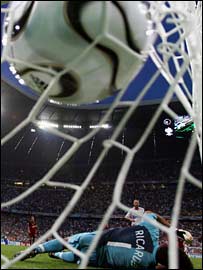
Zidane!

I'll always be partial to the King, but Zidane is my new French soccer hero. He even has a flashy Web page.

UPDATE: a great picture of Zidane's penalty kick against Portugal.
Friday, June 30, 2006
On Rhetoric
For the record, Fonseca Bin no. 27 is my favorite annual port (meaning it is produced every year and so is widely available ... truly high quality sweet wines are only produced when the grapes are just right and so are unpredictable).
A good friend thoughtfully gave me the Loeb with Plato's Symposium, Lysis and Gorgias for summer reading, and I have decided to work through Gorgias. If I keep an average pace of about 15 pages per week I should easily finish during the summer. I'll post comments here to keep myself accountable (cough).
As an opener: So far, Mr. W.R.M. Lamb ("sometime fellow of Trinity College, Cambridge") seems to have been an ironic choice to translate the dialogue on rhetoric, for his translation robs the speakers of some of their best demonstrations of wit. This is so important because Gorgias is the supreme rhetorician whose craft, as Socrates will demonstrate, has nothing to do with true knowledge and so is not a craft at all; besides, as we shall see, Socrates is better at it than everyone else.
Very Beginning (my own):
Kallikles: As they say, Socrates, you desire a war and battle so as to get a share (ie., just to get the spoils).
Socrates: Rather do you mean the saying, we have come too late for the feast?
K: Indeed and a most urbane feast. For just a moment ago Gorgias put on a varied and beautiful display for us.
S: Chaipheron here is to blame, having forced us to spend our time in the market place.
Get it? Kallikles has just listened to a display of rhetoric, but has learned nothing (because rhetoric has nothing true to teach) since he immediately proceeds to quote a useless proverb at his new quests. Kallikles calls the feast urbane; Socrates puns on the word complaining that he was stuck in the market (ie., the center of the city). Who's the rhetorician now? Who's the true teacher: the one at a feast giving a self congratulatory display of words at a posh dinner or the one in the market place with his students? Ta da, the themes of the dialogue summarized and proven in the first four lines. All of this is missed in Lamb's translation thanks to his unimaginative diction.
A good friend thoughtfully gave me the Loeb with Plato's Symposium, Lysis and Gorgias for summer reading, and I have decided to work through Gorgias. If I keep an average pace of about 15 pages per week I should easily finish during the summer. I'll post comments here to keep myself accountable (cough).
As an opener: So far, Mr. W.R.M. Lamb ("sometime fellow of Trinity College, Cambridge") seems to have been an ironic choice to translate the dialogue on rhetoric, for his translation robs the speakers of some of their best demonstrations of wit. This is so important because Gorgias is the supreme rhetorician whose craft, as Socrates will demonstrate, has nothing to do with true knowledge and so is not a craft at all; besides, as we shall see, Socrates is better at it than everyone else.
Very Beginning (my own):
Kallikles: As they say, Socrates, you desire a war and battle so as to get a share (ie., just to get the spoils).
Socrates: Rather do you mean the saying, we have come too late for the feast?
K: Indeed and a most urbane feast. For just a moment ago Gorgias put on a varied and beautiful display for us.
S: Chaipheron here is to blame, having forced us to spend our time in the market place.
Get it? Kallikles has just listened to a display of rhetoric, but has learned nothing (because rhetoric has nothing true to teach) since he immediately proceeds to quote a useless proverb at his new quests. Kallikles calls the feast urbane; Socrates puns on the word complaining that he was stuck in the market (ie., the center of the city). Who's the rhetorician now? Who's the true teacher: the one at a feast giving a self congratulatory display of words at a posh dinner or the one in the market place with his students? Ta da, the themes of the dialogue summarized and proven in the first four lines. All of this is missed in Lamb's translation thanks to his unimaginative diction.
Thursday, June 29, 2006
Thoughts on JKR
(1) Rowling said recently that two characters will die in the final Harry Potter novel. All fine and good. I want to know if any of them will come back to life.
(2) While reading Plato's Phaedrus to prepare to lead some discussions on it, I came across this passage:
For the prophetess in Delphi and the priestesses in Dodona when mad have accomplished many beautiful things for Greece both in private and in public, but little, or rather nothing, when of sound mind. And if we should speak of the Sibyl and others, who used divinely inspired prophesy to foretell in the future many things to many people and guide them aright, we would draw it [our speech] out at length, saying things that are clear to everyone. (244a-b, trans. Nichols)
Is this description not a deadringer for Trelawny? What was her first name again? Sibyl? I also wonder if Trelawny's penchant for sherry is based on her desire to lose herself in something other than herself so that she may prophesy. For she does not prophesy under her own power, but only when influenced by . . . ? What? God?
I've thought for a while now that the only thing in Harry Potter's world that is truly supernatural is prophecy. What about the magic, you say? Two things about the magic make it not so easily supernatural: it has to be learned by great study (that is why the students are at Hogwarts) and a fully developed natural science would be indistinguishable from magic. (Here I could throw in some quotation from Lewis's Abolition of Man about how magic and science both spring from the same desire, but you already know all that. But consider anyway this article describing how scientists will probably make something like Harry's invisibility cloak.)
John Granger has written a wonderful article on Harry Potter. Everyone should read it, especially critics. Among other things, the article points out in various places the tenuous nature of our understanding of the distinction between natural and supernatural. What is it to be supernatural? Is alchemy natural or not?
One thing I would add to his article is a mention of the existence of prophecy in the books. I think it is one of the clearest indicators Rowling's world is supernatural. And immersing ourselves in that world is indeed a powerful ally in helping us to live "fully human, which is to say 'spiritual,' lives" (Granger, last para.).
(2) While reading Plato's Phaedrus to prepare to lead some discussions on it, I came across this passage:
For the prophetess in Delphi and the priestesses in Dodona when mad have accomplished many beautiful things for Greece both in private and in public, but little, or rather nothing, when of sound mind. And if we should speak of the Sibyl and others, who used divinely inspired prophesy to foretell in the future many things to many people and guide them aright, we would draw it [our speech] out at length, saying things that are clear to everyone. (244a-b, trans. Nichols)
Is this description not a deadringer for Trelawny? What was her first name again? Sibyl? I also wonder if Trelawny's penchant for sherry is based on her desire to lose herself in something other than herself so that she may prophesy. For she does not prophesy under her own power, but only when influenced by . . . ? What? God?
I've thought for a while now that the only thing in Harry Potter's world that is truly supernatural is prophecy. What about the magic, you say? Two things about the magic make it not so easily supernatural: it has to be learned by great study (that is why the students are at Hogwarts) and a fully developed natural science would be indistinguishable from magic. (Here I could throw in some quotation from Lewis's Abolition of Man about how magic and science both spring from the same desire, but you already know all that. But consider anyway this article describing how scientists will probably make something like Harry's invisibility cloak.)
John Granger has written a wonderful article on Harry Potter. Everyone should read it, especially critics. Among other things, the article points out in various places the tenuous nature of our understanding of the distinction between natural and supernatural. What is it to be supernatural? Is alchemy natural or not?
One thing I would add to his article is a mention of the existence of prophecy in the books. I think it is one of the clearest indicators Rowling's world is supernatural. And immersing ourselves in that world is indeed a powerful ally in helping us to live "fully human, which is to say 'spiritual,' lives" (Granger, last para.).
Thursday, June 15, 2006
My New Pastime
Listening to the Dan Patrick Show on ESPN Radio. I grew up watching and playing sports, but I've drifted from those roots (mixed metaphor, I know) in the last ten years or so. But now I'm moving back to more sports.
The Dan Patrick show is on during the time when I drive back home from teaching a summer school class in logic. At first, I just listened because the long pauses between his sentences made me think something was wrong with my radio. Then I loved the fact that when people call in to the show, they give their height and weight.
What I like about the DPS is that it's not just about sports for sports' sake. I mean, he isn't talking about who's the greatest running back of all time. The last two days have covered interesting ethical issues.
(1) Does Ben Roethlisberger have a duty (obligation) to wear a motorcycle helmet?
(2) Was it immoral for Ozzie Guillen to tell his rookie pitcher, Sean Tracey, to hit Hank Blalock? And then was Tracey justified in not hitting Blalock? And was Guillen justified in demoting Tracey to triple-A ball for not hitting Blalock?
I'll actually discuss what I think are the relevant issues in (2) later.
The Dan Patrick show is on during the time when I drive back home from teaching a summer school class in logic. At first, I just listened because the long pauses between his sentences made me think something was wrong with my radio. Then I loved the fact that when people call in to the show, they give their height and weight.
What I like about the DPS is that it's not just about sports for sports' sake. I mean, he isn't talking about who's the greatest running back of all time. The last two days have covered interesting ethical issues.
(1) Does Ben Roethlisberger have a duty (obligation) to wear a motorcycle helmet?
(2) Was it immoral for Ozzie Guillen to tell his rookie pitcher, Sean Tracey, to hit Hank Blalock? And then was Tracey justified in not hitting Blalock? And was Guillen justified in demoting Tracey to triple-A ball for not hitting Blalock?
I'll actually discuss what I think are the relevant issues in (2) later.
Thursday, June 08, 2006
About Time
The Tigers beat the White Sox (for the first time this season) to hold on to first place and the best record in the league.
Subscribe to:
Posts (Atom)