2. But since those who imitate imitate those acting, and it is necessary that they be either serious or trivial[1] -- for the characters pretty much necessarily follow these alone, for everyone differs in character by vice or virtue[2] -- they imitate either those better than us or worse than us or those such as us, just as the painters. For the portrayals of Polygnotus are better, Pauson worse, and Dionysus similar (to us). And it's also clear that each of the imitations spoken of will have these differences and each will be different by imitating in this manner. For even in dance, aulos-playing, and cithara-playing these differences are possible, as well as in speeches and what is unmetered[3]: those of Homer are better, Cleophon worse, Hegemon the Thrasian, who first made parodies, and Nikochares, who made the Diliad, worse. And similarly also concerning dithyrambs and nomes[4], someone might likewise imitate as Timotheus and Philoxenus did the Cyclopes. And in this difference tragedy also stands apart from comedy: the former wants to imitate those worse, the latter those better, than those now.
3. And yet how someone might imitate each of these is a third difference of them. For even when the imitation is in the same things and of the same things, one might imitate[5] while reporting, either becoming someone different, as Homer does, or as the same person and not changing, or one might imitate as all those who imitate: acting and being at work. As we said at the beginning, imitation is in these three differences: in which, what, and how. So, in one way, as imitator Sophocles would be the same as Homer (for they both imitate serious things) but, in another way, as Aristophanes (for they both imitate those acting and doing). So some say the stage acts (dramata) are so called because they imitate doing (drwntas). Wherefore also the Dorians lay claim to tragedy and comedy -- for indeed the local Megarians lay claim to comedy as having come to be during their democracy, and the Sicilians lay claim for Epicharmus, the poet, was from there (much earlier than Chionides and Magnes), and some of the Peloponnesians lay claim to tragedy -- making names the sign. For the Dorians say they call the suburbs "komas" (though the Athenians call them "demes"), as if comedians were so called not from reveling (komazein) but from going komas to komas, driven in dishonor from the towns. And they name "doing," "dran," but the Athenians name it "prattein."
[1] spoudaious and phaulous
[2] arete and kakia
[3] Literally, "bare metered," which, I think, Thorgerson wants to call prose.
[4] From the OED: Nome: "In ancient Greece: a song or hymn sung in honour of the gods. Also: the genre to which such a song belongs."
[5] I supply the verb both here and below from the previous sentence.
General Note: I've always heard that the text of the Poetics is a mess, but after translating this section, I believe it on the basis of first-hand experience.
Thursday, June 07, 2007
My Idea of a Good Time . . .
. . . would be attending a seminar like this one. Robert George and Cornell West coteach a freshman seminar at Princeton on the great books. The article highlights their friendship, which is a beacon of virtue in an ocean of political and religious vitriol. (HT: Mere Comments)
Wednesday, June 06, 2007
Another Tribute to Fr. Michael
[The following was passed along from a friend.]
Father Michael passed away only twelve days before my ninth wedding anniversary. That number has significance only because it was Father Michael who, nine years ago, married Kari and myself, and only a month earlier it was he who had received us into the Orthodox Church.
What was to become our last encounter with Father Michael took place not within the comfortable confines of St. Michael Church, but in a most unexpected place. By chance (if one believes in such things) our paths crossed in the terminal at the Los Angeles International Airport. Kari and I were awaiting our return flight to Boston; he was returning from a trip to eastern Europe, travel-weary and physically weakened, but sharp-witted, debonair, and charming as ever. One could see why even such a close-knit people as the Gypsies had once let him into their confidence -- though not without stealing his wallet, of course.
It strikes me that the always profound and occasionally whimsical integrity with which Father Michael conducted his life is nowhere better illustrated than in the fate suffered by his wallet. It may well be that Elwood B. Trigg is the only person in history whom the Gypsies respected so much as to retrieve his wallet from a small mountain of purloined pocketbooks and return it. Whether Father Michael is truly unique in this regard I cannot say, but I am sure that he not only observed saints, he helped make them.
There is one memory of Father Michael that is almost (not quite) uniquely my own. Nine years ago I was crazy enough to schedule my wedding on the day after my university graduation. It happened at the time that the Evangelical university I attended (which shall remain nameless) had embarked upon a campaign to rid itself of Eastern Orthodox faculty, including then-Dean of Students, Father Michael. There were a few of us students who were Orthodox, to be sure, but it was the faculty who bore the brunt of the university’s vitriol, and Father Michael in particular. Nonetheless, when I received my diploma he left his seat among the Deans and, in front of the administration, faculty, and entire graduating class, greeted me with the kiss of peace.
The much-anticipated keynote address for the day was delivered by a well-known and popular Evangelical writer and speaker, who unfortunately became so choked up with emotion at the graduation of his own son that he could only utter the following words: "Husbands love your wives; fathers love your children." Despite the fact that I was to be married the following day, I found that speech profoundly disappointing, but time and the recent appearance of my own daughter have dulled my criticism. That weekend nine years ago I shared two memorable kisses. Since then I have loved my wife only imperfectly, and God knows I get frustrated when my five-month old refuses to go to sleep even though she is clearly tired. But Father Michael, who was never married, never wavered in his love for the Church and her children.
Father Michael passed away only twelve days before my ninth wedding anniversary. That number has significance only because it was Father Michael who, nine years ago, married Kari and myself, and only a month earlier it was he who had received us into the Orthodox Church.
What was to become our last encounter with Father Michael took place not within the comfortable confines of St. Michael Church, but in a most unexpected place. By chance (if one believes in such things) our paths crossed in the terminal at the Los Angeles International Airport. Kari and I were awaiting our return flight to Boston; he was returning from a trip to eastern Europe, travel-weary and physically weakened, but sharp-witted, debonair, and charming as ever. One could see why even such a close-knit people as the Gypsies had once let him into their confidence -- though not without stealing his wallet, of course.
It strikes me that the always profound and occasionally whimsical integrity with which Father Michael conducted his life is nowhere better illustrated than in the fate suffered by his wallet. It may well be that Elwood B. Trigg is the only person in history whom the Gypsies respected so much as to retrieve his wallet from a small mountain of purloined pocketbooks and return it. Whether Father Michael is truly unique in this regard I cannot say, but I am sure that he not only observed saints, he helped make them.
There is one memory of Father Michael that is almost (not quite) uniquely my own. Nine years ago I was crazy enough to schedule my wedding on the day after my university graduation. It happened at the time that the Evangelical university I attended (which shall remain nameless) had embarked upon a campaign to rid itself of Eastern Orthodox faculty, including then-Dean of Students, Father Michael. There were a few of us students who were Orthodox, to be sure, but it was the faculty who bore the brunt of the university’s vitriol, and Father Michael in particular. Nonetheless, when I received my diploma he left his seat among the Deans and, in front of the administration, faculty, and entire graduating class, greeted me with the kiss of peace.
The much-anticipated keynote address for the day was delivered by a well-known and popular Evangelical writer and speaker, who unfortunately became so choked up with emotion at the graduation of his own son that he could only utter the following words: "Husbands love your wives; fathers love your children." Despite the fact that I was to be married the following day, I found that speech profoundly disappointing, but time and the recent appearance of my own daughter have dulled my criticism. That weekend nine years ago I shared two memorable kisses. Since then I have loved my wife only imperfectly, and God knows I get frustrated when my five-month old refuses to go to sleep even though she is clearly tired. But Father Michael, who was never married, never wavered in his love for the Church and her children.
Poetics 1447b
Slightly overlaps for reasons of coherence, apologies …
[1] … And the imitation by prose[2] alone or by metred words (verse); and by metered words either
Thus if they were to produce some medical or naturalist[5] text in meter, they would be customarily likely to name it accordingly [as poetry]; but Homer and Empedocles have nothing in common besides the meter, wherefore to name the poetic work justly, the latter [Empedocles] would be a naturalistic text rather than a poetic work. Similarly if anyone should craft an imitation joining quite every one of the meters together (just as Chairemon crafted the mixed rhapsody “Centuar” from quite every one of the meters),
Concerning these things, then, let this distinguish the matter.
There are some
[1] I agreed with Christ’s punctuation more than Fyfe (the Loeb edition of 1965 that I am using) in that the thought (with Burglar’s translation): “all make the imitation in rhythm and speech and harmony” is the beginning of a somewhat disorganized digression on three different ways that “rhythm, word and harmony” can be seperately or jointly employed in different poetic “imitations”: instrument-playing, dancing and word-compositions.
[2] Phrase literally “bare words” often means “prose”, which makes the most sense here.
[3] Editors have inserted “anwnumos” meaning “nameless” here based on an Arabic text so that the translation would be something like, “a single kind of those metres employed up to the present day which happen to be nameless …” This makes sense with the explanation Aristotle then embarks upon, but I think obscures the real point: the next section is an explanation for why he had to be so vague as to use the phrase “a single kind of those metres which happen to be employed at the present time”—he is being intentionally vague because the terms currently in use (Athens, circa 4th c. BC) are inadequate, which he is trying to correct. Understand the next section as Aristotle’s deconstruction of current categories of labelling according to appearance instead of (what he wants to do) labelling according to the means of “crafting an imitation”.
[4] EDITED. Re: Burglar's efforts to bring my overtranslating back to earth, I have dumped "poetically create an imitation" and now use will use:
"craft" as a translation for the verb "poiew" (as in 'craft a poem')
"poetic work" as a translation for the noun "poeisis"
"craft an imitation" as a translation for the repeated phrase "poeiw mimesin".
This is bound to change, so stay tuned.
[5] I use “naturalist” in the classical Aristotelean sense of “natural philosopher” or “natural scientist” which I think is still more accurate than saying simply “scientist.”
[6] EDITED. This "in which" is a translation of the Greek preposition "en" which is usually just translated as I did here with "in". In the koine Greek of the New Testament, a very frequent 'agreed upon by the authorities' translation of this preposition is "by" as in "by means of". That is more the sense that I get from this sentence as well as the earlier statement it is referring to (see the end of I.4--Burglar's translation: "all make the imitation IN rhythm and speech and harmony"). "In" works perfectly well because we also say for instance a poem "in meter", but the important point for Ar. seems to be that they are imitations IN verse the same way a painting would be an imitation IN oils or IN watercolors -- these different categories of POETIC imitation are separated by the medium they rely on for that imitation.
So, a brief summary of how I understand Aristotle so far: poetic imitations should be so called no matter what form of rhythm or harmony or word, whether of prose, verse or combinations thereof they use, because what matters is whether or not they are “poetically creating an imitation” through a certain set of means. Categories for distinguishing these poetic imitations from each other:
1. the kind of imitation (ie., rhythms, words, harmonies)
2. the object of imitation (heroes or philosophers or lovers, etc)
3. the manner or style of imitation (ie., within the “kinds”, ‘words’ could use prose, verse, or combinations thereof)
Distinguishing poetic imitation from other imitative crafts, such as painting, whereby one also imitates (see I.4a), is the means of imitation (thus the insane frequency of the dative case in these pages). Painters imitate by means of copying postures of figures and colors; the poetic imitations by means of everything you can do with “sound” (I.4b).
Tuesday, June 05, 2007
Poetics 1447a
Concerning the poetic art -- both itself and its forms, what unique power each has, and how it's necessary to combine the stories if one intends to have poetry beautifully, and out of how many and of what sorts are (its) proper parts, and similarly concerning the others inasmuch as it is of (the same line of) inquiry -- let us speak from the first of the first things according to nature.
Epic poetry and the poetry of tragedy, and also comedy and the art of the dithyrambic poetry, most of the art of the aulos and the art of the cithara, all happen to be, altogether, imitations; but they (imitations) differ from one another in three ways, for (they differ) either by being imitations in (en) different things, of different things, or differently and not in the same manner. For just as some who make semblances imitate many things by colors and figures (some through art and some through convention) and others through the voice[1], so also in the arts spoken of[2] all make the imitation in rhythm and speech and harmony, but these either apart or mixed together, as, for example, both the art of the aulos and the art of the cithara and whatever power happens to be such as these[3], such as the pipes, use harmony and rhythm alone. But the art[4] of the dancers imitates[5] the rhythm itself apart from harmony, for they also imitate, by the arrangement of the rhythms, characters, experiences, and actions. But the art which by bare speeches alone and the one (using) measures, either mixing with the one another or using some one genus of measures, are until now without names. . . .
[1] Christ's text, which I'm using, has "tes phuseos" instead of "tes phones," which would require the translation "nature" instead of "the voice."
[2] Christ breaks the sentence differently than most. He ends 1447a21 after "technais," and begins the next sentence with "hapasai," which runs until 1447a28, where it ends (with a semicolon) after "praxeis." My translation doesn't follow Christ's text here.
[3] Bracketed by Christ.
[4] Supplied by the eta, which I think elides "techne."
[5] Bracketed by Christ (and others).
[6] Bracketed by Christ.
Epic poetry and the poetry of tragedy, and also comedy and the art of the dithyrambic poetry, most of the art of the aulos and the art of the cithara, all happen to be, altogether, imitations; but they (imitations) differ from one another in three ways, for (they differ) either by being imitations in (en) different things, of different things, or differently and not in the same manner. For just as some who make semblances imitate many things by colors and figures (some through art and some through convention) and others through the voice[1], so also in the arts spoken of[2] all make the imitation in rhythm and speech and harmony, but these either apart or mixed together, as, for example, both the art of the aulos and the art of the cithara and whatever power happens to be such as these[3], such as the pipes, use harmony and rhythm alone. But the art[4] of the dancers imitates[5] the rhythm itself apart from harmony, for they also imitate, by the arrangement of the rhythms, characters, experiences, and actions. But the art which by bare speeches alone and the one (using) measures, either mixing with the one another or using some one genus of measures, are until now without names. . . .
[1] Christ's text, which I'm using, has "tes phuseos" instead of "tes phones," which would require the translation "nature" instead of "the voice."
[2] Christ breaks the sentence differently than most. He ends 1447a21 after "technais," and begins the next sentence with "hapasai," which runs until 1447a28, where it ends (with a semicolon) after "praxeis." My translation doesn't follow Christ's text here.
[3] Bracketed by Christ.
[4] Supplied by the eta, which I think elides "techne."
[5] Bracketed by Christ (and others).
[6] Bracketed by Christ.
In Which Thorgerson and I Translate Aristotle's Poetics
Thorgerson and I have decided to do some translation work on this blog. We're starting with the Poetics. Feel free to use the comments to correct our work.
Monday, June 04, 2007
Quotation on a Work of Plato's
"The Lysis is hard. The Theory of Forms doesn't make it any easier."
--R. M. Dancy, Plato's Introduction of Forms, p. 206.
--R. M. Dancy, Plato's Introduction of Forms, p. 206.
Sunday, June 03, 2007
How to Feel Old Twice in One Weekend
1. Watch a baseball game in which the teams are wearing "throwback" jerseys. Say to self, "Wait a minute, those can't be throwback jerseys. I remember watching games when those jerseys were the regular season uniforms. Oh, that's right, I'm old."
2. Read the list of people up for induction into the baseball hall of fame. Say to self, "Wait a minute, how can all these people be up for the hall of fame already? I have all their baseball cards. Oh, that's right, I'm old."
2. Read the list of people up for induction into the baseball hall of fame. Say to self, "Wait a minute, how can all these people be up for the hall of fame already? I have all their baseball cards. Oh, that's right, I'm old."
Saturday, June 02, 2007
Should the Tigers Put Out a Want Ad for a Closer?
One thing I like about Todd Jones is his directness. He said, after giving up five runs in the ninth to the Indians, "I got pounded. We needed a win against these guys. We needed a win for ourselves and I didn't get it done. I just got crushed."
Yes he did. The question is whether getting pounded and crushed signifies a bump in the road or the end of the line.
Yes he did. The question is whether getting pounded and crushed signifies a bump in the road or the end of the line.
Be Afraid, But of Whom?
In his post on the kind of person Americans should elect for the next president, Dr. Reynolds states,
In this next election, we must avoid a person with no community or willingness to live for a cause bigger than self. . . . Sadly, the man controlled by his passions who lives for nothing bigger than self is the goal of much of modern media. Such men are always the most dangerous leaders, especially when their corrupted natures are combined with great gifts. In the next election, I fear the candidate with no center, who has risen too quickly, and who has never lived for a cause greater than himself.
Whether or not he's right about this, I won't say. But the idea we seem to have of a person who has given himself over to "a cause greater than himself" is that he is dangerous precisely because he could be controlled by something other than himself. Weren't the Nazis bad (at least in part) because they were mindless slaves to something -- they had given themselves over to a cause greater than themselves? Weren't the good people in Germany the ones who stood against Hitler -- they stood up for themselves?
Clearly there can be trouble with both positions, but if Reynolds is right, then we're wrong to fear the person who's given over to a cause greater than himself more than the person who lives for himself. The person who lives only for himself is more dangerous than the person who lives for a cause greater than himself. But, at least in the context of a presidential election, we should be less worried about fanaticism than self-indulgence.
Perhaps we might be mixed up about this because we don't know of any causes genuinely greater than ourselves. That is to say, in the case of the Nazis, were they really given over to a cause greater than themselves, or were they merely given over to their passions in a disguised way?
Or perhaps it's because we don't have a good model of how someone could be his own man and at the same time serve a cause greater than himself.
In this next election, we must avoid a person with no community or willingness to live for a cause bigger than self. . . . Sadly, the man controlled by his passions who lives for nothing bigger than self is the goal of much of modern media. Such men are always the most dangerous leaders, especially when their corrupted natures are combined with great gifts. In the next election, I fear the candidate with no center, who has risen too quickly, and who has never lived for a cause greater than himself.
Whether or not he's right about this, I won't say. But the idea we seem to have of a person who has given himself over to "a cause greater than himself" is that he is dangerous precisely because he could be controlled by something other than himself. Weren't the Nazis bad (at least in part) because they were mindless slaves to something -- they had given themselves over to a cause greater than themselves? Weren't the good people in Germany the ones who stood against Hitler -- they stood up for themselves?
Clearly there can be trouble with both positions, but if Reynolds is right, then we're wrong to fear the person who's given over to a cause greater than himself more than the person who lives for himself. The person who lives only for himself is more dangerous than the person who lives for a cause greater than himself. But, at least in the context of a presidential election, we should be less worried about fanaticism than self-indulgence.
Perhaps we might be mixed up about this because we don't know of any causes genuinely greater than ourselves. That is to say, in the case of the Nazis, were they really given over to a cause greater than themselves, or were they merely given over to their passions in a disguised way?
Or perhaps it's because we don't have a good model of how someone could be his own man and at the same time serve a cause greater than himself.
Saturday, May 26, 2007
Gut Check for Tigers
UPDATE: Getting swept at home is never a good sign, and after tonight's loss against the Indians, what I said originally seems stronger. The Tigers need to take at least three games against the Indians this weekend to redeem themselves and two games to keep in the fray of the AL Central. It's not the end of the world, though, even if they don't win two since they play eighteen times this year.
ORIGINAL POST: Don't let the Tigers' record or their close second-place standing fool you. They're not a big-time club yet this year. My criterion for this assessment is how they've fared against quality teams. This year, they've played two quality teams: Boston and Cleveland. They've lost three out of four to Boston, and they've just lost two in a row to Cleveland at home. A big test will be tomorrow against Cleveland and then next weekend's four-game jaunt in Jacobs Field. Not winning at least three of their next five games against Cleveland will put a damper on things, and they might fall into company with the Twins at the back of the AL Central. (The Royals don't count in the AL Central standings since they're always in the very back.)
But don't think that my pessimism has reached its limit. The Tigers are doing well for being without Kenny Rogers and Joel Zumaya. And Jim Leyland won't let them stay down too long.
ORIGINAL POST: Don't let the Tigers' record or their close second-place standing fool you. They're not a big-time club yet this year. My criterion for this assessment is how they've fared against quality teams. This year, they've played two quality teams: Boston and Cleveland. They've lost three out of four to Boston, and they've just lost two in a row to Cleveland at home. A big test will be tomorrow against Cleveland and then next weekend's four-game jaunt in Jacobs Field. Not winning at least three of their next five games against Cleveland will put a damper on things, and they might fall into company with the Twins at the back of the AL Central. (The Royals don't count in the AL Central standings since they're always in the very back.)
But don't think that my pessimism has reached its limit. The Tigers are doing well for being without Kenny Rogers and Joel Zumaya. And Jim Leyland won't let them stay down too long.
Thursday, May 24, 2007
Which Merchant Is Which?
I assigned The Merchant of Venice for one of my classes this spring. Two students made passing comments in their essays that they thought Antonio was the title character. I've always assumed it was Shylock (or, as one student insisted on writing in his essay, "the Shylock").
So that got me thinking about whether the title refers to Antonio or Shylock. And that got me thinking about the titles of Shakespeare's plays in general. It's always difficult to categorize his plays, but their ordering in The Riverside Shakespeare reveals a pattern: With the exception of Troilus and Cressida (and does that play deserve to be called a comedy?), none of the comedies have a proper name in the title. Those titles that refer to someone always have a description (e.g., The Two Gentleman of Verona, The Merry Wives of Windsor, The Taming of the Shrew). But all the tragedies are titled for a particular person (e.g., Hamlet, Othello, King Lear).
(Now, I know that Shakespeare may not have been responsible for titling all his plays, but at least the tradition has settled on this pattern.)
(1) I wonder if there is any significance to this pattern. I can't think of any except that the tragedies are more arresting in their ability to teach the audience. That is, "You don't want to end up like Hamlet, do you?" On the other hand, it's difficult for audiences to take the comedies as having any didactic purpose; I say it's difficult, though I don't think Shakespeare thought of tragedies as more profound than comedy (see the end of Plato's Symposium on tragedy and comedy). Perhaps the eponymous tragic figure makes the title more appropriate.
(2) I still don't know who the merchant of Venice is. I think it's Shylock, and I think the best way to figure it out is to examine the other comedies with titles describing members of the dramatis personae. Since I'm supposed to be writing a dissertation, that extracurricular research will have to wait.
(3) But what will it matter if the merchant of Venice turns out to be Antonio and not Shylock? That seems to be the question to consider moving forward.
So that got me thinking about whether the title refers to Antonio or Shylock. And that got me thinking about the titles of Shakespeare's plays in general. It's always difficult to categorize his plays, but their ordering in The Riverside Shakespeare reveals a pattern: With the exception of Troilus and Cressida (and does that play deserve to be called a comedy?), none of the comedies have a proper name in the title. Those titles that refer to someone always have a description (e.g., The Two Gentleman of Verona, The Merry Wives of Windsor, The Taming of the Shrew). But all the tragedies are titled for a particular person (e.g., Hamlet, Othello, King Lear).
(Now, I know that Shakespeare may not have been responsible for titling all his plays, but at least the tradition has settled on this pattern.)
(1) I wonder if there is any significance to this pattern. I can't think of any except that the tragedies are more arresting in their ability to teach the audience. That is, "You don't want to end up like Hamlet, do you?" On the other hand, it's difficult for audiences to take the comedies as having any didactic purpose; I say it's difficult, though I don't think Shakespeare thought of tragedies as more profound than comedy (see the end of Plato's Symposium on tragedy and comedy). Perhaps the eponymous tragic figure makes the title more appropriate.
(2) I still don't know who the merchant of Venice is. I think it's Shylock, and I think the best way to figure it out is to examine the other comedies with titles describing members of the dramatis personae. Since I'm supposed to be writing a dissertation, that extracurricular research will have to wait.
(3) But what will it matter if the merchant of Venice turns out to be Antonio and not Shylock? That seems to be the question to consider moving forward.
Wednesday, May 23, 2007
Jones!

Liveblogging Todd Jones's "relief" appearance against the Angels (5/23/07)
Top of ninth, Tigers lead 8-6
Reggie Willits
1: Strike
2: Ball
3: Foul
4: Foul
5: Hit (infield single off Jones's glove)
Orlando Cabrera
1: Ball
2: Ball (some controversy about whether Cabrera swung; it seems he did); Willits steals second
NB: Classic Jones start: Get a runner on second, nobody out.
3: Foul
4: Base hit to left
NB: Still on track for a classic Jones: Nobody out, runners on first and third, now facing the other team's best hitter.
Vladimir Guerrero
1: Foul
2: Hits into double play; run scores
NB: More classic Jones: Give up a run, get two outs.
Gary Matthews, Jr.
1: Ball
2: Flies out to center
As you can see, this outing meets all the necessary and sufficient conditions for a "classic Jones."
1. Jones must come on with more than a one-run lead so that he can give up at least one run.
2. Jones must get runners on the bases early from a fluke hit or error.
3. Jones must face one of the other team's top hitters.
4. Jones must benefit from a solid defensive play.
5. Jones must give up a run (often in exchange for an out or two).
6. Jones must let the other team hit into the final out; the motive here seems to be to avoid striking anyone out.
Perhaps you can also surmise from this that Jones is the leading cause of anxiety among Tigers' fans.
Tuesday, May 22, 2007
Using RSS for School (Really)
I discovered that a number of academic journals that I should be keeping up with publish their tables of contents via RSS feeds. I now have a list of about twenty journals in my Bloglines, and I don't have to worry about whether I've missed the latest edition of Mind or Arabic Sciences and Philosophy or The Classical Review. And since I have access to a major university library, all the articles are usually available for me to read online. But you don't have to have a subscription to the online version of the journal in order to get the RSS feeds.


Friday, May 18, 2007
The "Truth Connection" an Excuse to Be Rude?
Andrew at Ratiocination reminds us of Plantinga's defense against de jure objections to Christianity.
Alvin Plantinga distinguishes between de jure and de facto objections to Christian belief. De facto objections say that some Christian doctrine is false, while de jure objections say that some Christian doctrine is inappropriate, irrational, or unjustified. Plantinga also famously argues that a successful de jure objection requires a successful de facto objection. The truth of the matter about Christian belief is linked to its epistemic status in at least the following way: if it’s true than it’s warranted.
Andrew dubs this the "truth connection": if an objection is true, then it is permissible to make it; otherwise, not.
Then he discusses whether the same point can be made in other contexts. For example, some current criticisms of Jerry Falwell's opinions have been decried as improper. Couldn't one think that the de jure objection, "that's improper," depends upon a de facto objection, "what Falwell believed really was false or bad."
But doesn't the context of the objection matter? For it seems there's a healthy place for observing manners and etiquette. If someone is overweight, and I tell them in front of a huge crowd that they need to lose weight, someone should tell me I'm out of line. I don't think it will do for me to say, "Well, that's just a de jure objection, but it's really true that so-and-so needs to lose weight so you ought not tell me that I shouldn't have said that."
Similarly with Falwell. I don't think people are suggesting that Hitchins might not be right about Falwell. The reasonable objection seems to be that what he's saying ought not be said right this very moment.
I take it Plantinga's response to de jure objections doesn't need to take into account contexts like this. He's discussing the rationality and truth of Christianity in abstracto.
Alvin Plantinga distinguishes between de jure and de facto objections to Christian belief. De facto objections say that some Christian doctrine is false, while de jure objections say that some Christian doctrine is inappropriate, irrational, or unjustified. Plantinga also famously argues that a successful de jure objection requires a successful de facto objection. The truth of the matter about Christian belief is linked to its epistemic status in at least the following way: if it’s true than it’s warranted.
Andrew dubs this the "truth connection": if an objection is true, then it is permissible to make it; otherwise, not.
Then he discusses whether the same point can be made in other contexts. For example, some current criticisms of Jerry Falwell's opinions have been decried as improper. Couldn't one think that the de jure objection, "that's improper," depends upon a de facto objection, "what Falwell believed really was false or bad."
But doesn't the context of the objection matter? For it seems there's a healthy place for observing manners and etiquette. If someone is overweight, and I tell them in front of a huge crowd that they need to lose weight, someone should tell me I'm out of line. I don't think it will do for me to say, "Well, that's just a de jure objection, but it's really true that so-and-so needs to lose weight so you ought not tell me that I shouldn't have said that."
Similarly with Falwell. I don't think people are suggesting that Hitchins might not be right about Falwell. The reasonable objection seems to be that what he's saying ought not be said right this very moment.
I take it Plantinga's response to de jure objections doesn't need to take into account contexts like this. He's discussing the rationality and truth of Christianity in abstracto.
Another Difference between Tolkien's and Jackson's LOTR
Matt at Mere Orthodoxy discusses one point on which Peter Jackson's movie version of The Lord of the Rings seems to miss an important point of Tolkien's book. I'd like to suggest another: the cause of the Ents' going to war.
The Ents, one of Tolkien's most original creations, are characterized in the book as being, above all, not hasty. The Entmoot (a council meeting for Ents) at which the Ents decide to go to war takes a long time: at least a couple of days. As Treebeard says, "we are not hasty folk." But the meeting takes such a long time because Treebeard wants to acquaint the other Ents with the facts concerning Saruman. But, says Treebeard, "deciding what to do does not take Ents so long as going over all the facts and events that they have to make up their minds about." In the book, after deliberating for three days, the Ents decide to go to war.
This is in accord with the teaching of Aristotle; he says in the Nicomachean Ethics that "one ought to be quick to do what has been deliberated, but to deliberate slowly" (1142b).
In the movie, as many readers know, the Ents decide at the Entmoot to not go to war. The hobbits then decide, reluctantly, to return home and ask Treebeard to carry them to the edge of the forest. When they come to the edge, they discover that Saruman has destroyed much of the forest, including many trees under Treebeard's care. As a result of this discovery, Treebeard goes into a rage and summons the other Ents to war.
Now, one might claim that three-day meetings between talking, walking trees do not make for good movies. That's probably true. (In this respect, filming the Council of Elrond is much more difficult because there the viewer needs that information.) But I don't see why the movie couldn't have filmed the Entmoot as it did and then stayed true to the Ents' choice as they make it in the book.
One conclusion that may reasonably be drawn from the movie's "adaptation" is that the screenwriters think the decision to go to war cannot be the result of careful deliberation. It must be the result of a hasty action, which itself is done as a result of passion (usually anger).
Or, at least if the screenwriters don't believe this, they believe that audiences will not find the book's version convincing. But that seems to be because modern audiences do not find the method employed by the Ents of the book as a plausible way to make decisions in general. That is, the majority of people make decisions based on an overwhelming feeling. Perhaps acting decisively after careful, lengthy deliberation is too foreign to many moviegoers today.
Aristotle would not be pleased (and, in fact, would not even deign to call what the Ents do in the movie "making a choice," since he thinks that choice requires deliberation).
I don't think it's a stretch to suggest that this particular difference, though in some sense minor, reveals Tolkien's receptiveness to Christian just-war doctrine and the moviemakers' discomfort with that doctrine. Though in this judgment, perhaps I am being too hasty.
The Ents, one of Tolkien's most original creations, are characterized in the book as being, above all, not hasty. The Entmoot (a council meeting for Ents) at which the Ents decide to go to war takes a long time: at least a couple of days. As Treebeard says, "we are not hasty folk." But the meeting takes such a long time because Treebeard wants to acquaint the other Ents with the facts concerning Saruman. But, says Treebeard, "deciding what to do does not take Ents so long as going over all the facts and events that they have to make up their minds about." In the book, after deliberating for three days, the Ents decide to go to war.
This is in accord with the teaching of Aristotle; he says in the Nicomachean Ethics that "one ought to be quick to do what has been deliberated, but to deliberate slowly" (1142b).
In the movie, as many readers know, the Ents decide at the Entmoot to not go to war. The hobbits then decide, reluctantly, to return home and ask Treebeard to carry them to the edge of the forest. When they come to the edge, they discover that Saruman has destroyed much of the forest, including many trees under Treebeard's care. As a result of this discovery, Treebeard goes into a rage and summons the other Ents to war.
Now, one might claim that three-day meetings between talking, walking trees do not make for good movies. That's probably true. (In this respect, filming the Council of Elrond is much more difficult because there the viewer needs that information.) But I don't see why the movie couldn't have filmed the Entmoot as it did and then stayed true to the Ents' choice as they make it in the book.
One conclusion that may reasonably be drawn from the movie's "adaptation" is that the screenwriters think the decision to go to war cannot be the result of careful deliberation. It must be the result of a hasty action, which itself is done as a result of passion (usually anger).
Or, at least if the screenwriters don't believe this, they believe that audiences will not find the book's version convincing. But that seems to be because modern audiences do not find the method employed by the Ents of the book as a plausible way to make decisions in general. That is, the majority of people make decisions based on an overwhelming feeling. Perhaps acting decisively after careful, lengthy deliberation is too foreign to many moviegoers today.
Aristotle would not be pleased (and, in fact, would not even deign to call what the Ents do in the movie "making a choice," since he thinks that choice requires deliberation).
I don't think it's a stretch to suggest that this particular difference, though in some sense minor, reveals Tolkien's receptiveness to Christian just-war doctrine and the moviemakers' discomfort with that doctrine. Though in this judgment, perhaps I am being too hasty.
Wednesday, March 28, 2007
I'm Already Judging This Book by Its Cover
It's been that time of year when I (professedly) neither read nor write blog posts. But I had to come out of hiding to show you all what you already know.


Monday, March 05, 2007
Salvation in Our Day
Are Ascetics the Only Serious Christians?
A Reflection from The Prologue of Ohrid: A Monk on Monasticism (January 31)
Although the Holy Fathers praised monasticism as the angelic state, and although many of the greatest saints lived their lives and attained perfection in the soundless and lifeless desert, nevertheless, the Orthodox Church does not recommend the tonsure to all the faithful. "Neither were all those in the desert saved nor were all those in the world lost," said one saint. To a city dweller who, with no inclination for monasticism, desired to enter the monastery, St. Niphon said, "My child, a place neither saves nor destroys a man, but deeds save or destroy. For him who does not fulfill all the commandments of the Lord, there is no benefit from a sacred place or from a sacred rank. King Saul lived in the midst of royal luxury and he perished. King David lived in the same kind of luxury and he was saved. Judas was numbered among the apostles and he went to hades. Whoever says that it is impossible to be saved with a wife and children deceives himself. Abraham had a wife and children, 318 servants and handmaidens and much gold and silver, but, nevertheless, he was called the Friend of God. Oh, how many servants of the Church and lovers of the desert have been saved! How many aristocrats and soldiers! How many artisans and field-workers! Be pious and be a lover of men, and you will be saved!"
To Resist Temptation and Flee the Devil
A Reflection from The Prologue of Ohrid: A Monk on the Last Days (February 5)
The monks asked the great Abba Ischyrion, "What have we done?"
"We have fulfilled the commandments of God," Ischyrion replied.
"And what will those do who come after us?"
"They will do what we do, but only half as much."
"And those after them?"
"Before the end of time, they will not keep the monastic rule, but such misfortunes and temptations will befall them that, through their patience during those assaults and temptations, they will prove themselves greater than us and our fathers in the Kingdom of God."
A Reflection from The Prologue of Ohrid: A Monk on Monasticism (January 31)
Although the Holy Fathers praised monasticism as the angelic state, and although many of the greatest saints lived their lives and attained perfection in the soundless and lifeless desert, nevertheless, the Orthodox Church does not recommend the tonsure to all the faithful. "Neither were all those in the desert saved nor were all those in the world lost," said one saint. To a city dweller who, with no inclination for monasticism, desired to enter the monastery, St. Niphon said, "My child, a place neither saves nor destroys a man, but deeds save or destroy. For him who does not fulfill all the commandments of the Lord, there is no benefit from a sacred place or from a sacred rank. King Saul lived in the midst of royal luxury and he perished. King David lived in the same kind of luxury and he was saved. Judas was numbered among the apostles and he went to hades. Whoever says that it is impossible to be saved with a wife and children deceives himself. Abraham had a wife and children, 318 servants and handmaidens and much gold and silver, but, nevertheless, he was called the Friend of God. Oh, how many servants of the Church and lovers of the desert have been saved! How many aristocrats and soldiers! How many artisans and field-workers! Be pious and be a lover of men, and you will be saved!"
To Resist Temptation and Flee the Devil
A Reflection from The Prologue of Ohrid: A Monk on the Last Days (February 5)
The monks asked the great Abba Ischyrion, "What have we done?"
"We have fulfilled the commandments of God," Ischyrion replied.
"And what will those do who come after us?"
"They will do what we do, but only half as much."
"And those after them?"
"Before the end of time, they will not keep the monastic rule, but such misfortunes and temptations will befall them that, through their patience during those assaults and temptations, they will prove themselves greater than us and our fathers in the Kingdom of God."
Monday, February 12, 2007
Classic Bill Simmons
"Anyway, Mary J. Blige wins for 'The Breakthrough' and thanks Jesus Christ AND God. Let's hope they're watching together."
Monday, January 29, 2007
Husserl's Investigations
In what way are the investigations comprising Husserl's Logical Investigations logical? It could be that they are like criminal investigations, in which the investigations are not themselves criminal but merely investigations into criminal matters. Thus, Husserl could be investigating logic in the sense that the subject of the investigations is logic.
But they could also be like an efficient investigation, where "efficient" indicates the manner in which the investigations are carried out. Thus, Husserl could be investigating logic in the sense that he is carrying out his investigations in a logical manner.
If the first sense is true, then one wants to know if there is a prescribed manner for carrying out the investigation into logic. (Presumably, one would have to do it logically; but is that all?) If the second, then one wants to know what the subject of the investigation is.
But they could also be like an efficient investigation, where "efficient" indicates the manner in which the investigations are carried out. Thus, Husserl could be investigating logic in the sense that he is carrying out his investigations in a logical manner.
If the first sense is true, then one wants to know if there is a prescribed manner for carrying out the investigation into logic. (Presumably, one would have to do it logically; but is that all?) If the second, then one wants to know what the subject of the investigation is.
Friday, January 26, 2007
Buying Virtuously
Ladybug, of Two Hungry Souls, posted the following question after she purchased a Kitchenaid 750 food processor for only $85: Is buying something so good for so much less than it is worth the act of a properly virtuous person?
Here's what I wrote in the comments of her blog.
It seems like the relevant virtue is the one concerning wealth, namely, generosity (the two vices are miserliness and prodigality). For, as the Philosopher says, "the person who will use wealth best is the one who has the virtue that is connected with money, and this is the generous person" (EN 4.1). He also says, "Actions in accord with virtue are beautiful [kalai] and are for the sake of the beautiful [kalou]; the generous person, then, will give for the sake of the beautiful, and in the right way, for it goes along with right giving that it be to whom and as much as and when one ought. . . . And it involves doing these things with pleasure, or without pain, for what comes from virtue is pleasant, or painless -- least of all things is it painful. But one who gives to whom one ought not, or not for the sake of the beautiful but for some other reason, would not be called generous but some other name." Lastly, he says, "it is most definitely characteristic of a generous person to go to excess in the giving, so that less is left for himself, for not looking out for oneself is part of being generous."
Now, it seems that the Philosopher would say this about bargain hunting: If you are spending money for the sake of the beautiful, that's an indication of your being generous. The more money you spend on the beautiful indicates a deeper generosity. This is where Aristotle's admission that whether or not you are completely virtuous is not entirely up to your will. For example, a person who is wealthier than you will be able to exercise the virtue of generosity more than you. But it seems you can still be generous, though perhaps not as often since you must also exercise prudence in ways a wealthy person does not.
Whether or not you are being unjust to the laborer who produced your Kitchenaid 750 depends on whether he has a claim on you for repayment. But it seems he does not, at least in the case of a corporation like Kitchenaid since the laborer is paid by the owner/manager of Kitchenaid. The laborer is not contracting with the customer; the laborer is contracting with the owner.
So the question is whether you own the owner anything. And it seems not, since the owner is willing to sell to you (or another middleman) for a low price.
Here's what I wrote in the comments of her blog.
It seems like the relevant virtue is the one concerning wealth, namely, generosity (the two vices are miserliness and prodigality). For, as the Philosopher says, "the person who will use wealth best is the one who has the virtue that is connected with money, and this is the generous person" (EN 4.1). He also says, "Actions in accord with virtue are beautiful [kalai] and are for the sake of the beautiful [kalou]; the generous person, then, will give for the sake of the beautiful, and in the right way, for it goes along with right giving that it be to whom and as much as and when one ought. . . . And it involves doing these things with pleasure, or without pain, for what comes from virtue is pleasant, or painless -- least of all things is it painful. But one who gives to whom one ought not, or not for the sake of the beautiful but for some other reason, would not be called generous but some other name." Lastly, he says, "it is most definitely characteristic of a generous person to go to excess in the giving, so that less is left for himself, for not looking out for oneself is part of being generous."
Now, it seems that the Philosopher would say this about bargain hunting: If you are spending money for the sake of the beautiful, that's an indication of your being generous. The more money you spend on the beautiful indicates a deeper generosity. This is where Aristotle's admission that whether or not you are completely virtuous is not entirely up to your will. For example, a person who is wealthier than you will be able to exercise the virtue of generosity more than you. But it seems you can still be generous, though perhaps not as often since you must also exercise prudence in ways a wealthy person does not.
Whether or not you are being unjust to the laborer who produced your Kitchenaid 750 depends on whether he has a claim on you for repayment. But it seems he does not, at least in the case of a corporation like Kitchenaid since the laborer is paid by the owner/manager of Kitchenaid. The laborer is not contracting with the customer; the laborer is contracting with the owner.
So the question is whether you own the owner anything. And it seems not, since the owner is willing to sell to you (or another middleman) for a low price.
Thursday, December 21, 2006
Harry Potter and the Deathly Hallows
UPDATE: The Hogwarts Professor (aka, John Granger) has inaugurated his blog with a huge post on "deathly hallows." As always, it's much deeper than you think it could be.
ORIGINAL: This is the title of the last Harry Potter novel due out (one hopes) next year. Of course, we all know that "hallow" is associated with being holy or being venerated (usually because of holiness), hence the phrase in the Lord's prayer "hallowed by Thy name." But the OED gives many definitions of "hallow." I think the relevant definition of "hallows" is the following: "In pl. applied to the shrines or relics of saints; the gods of the heathen or their shrines." In this case, though there has been speculation about graveyards (e.g., Harry's parents, or a graveyard at Hogwarts) as the hallows, I think it must be a reference to Voldemort's you-know-whats. Hence, the deathly hallows.
Or, Rowling is throwing us all off the scent and is thinking of another meaning of "hallow" in the OED: "The parts of the hare given to hounds as a reward or encouragement after a successful chase." Run away! Run away! It's the deathly rabbit parts! (No longer undetached, for you Quine readers.)
And, I don't think the reader ("Sirius") quoted in the news story linked to at the beginning of this post realizes what his worry reveals about his understanding of the Harry Potter series. He said, "This title has me a bit worried. For one thing, it has me concerned that Harry's gonna die . . . which I really DON'T want to see happen." Yes, death is a serious thing, even for a fictional character. But the worry that Harry will die indicates that the reader hasn't taken to heart a basic message of the books: there are things worse than physical death and if faced with a choice between death and doing right, one should do right with the assurance that love remains stronger than death.
I don't want to see Harry die either. But if it comes down to it, I'd rather see Harry die than not do the right thing. Perhaps the concerned reader, in his heart of hearts, thinks that, too, but is afraid. That's understandable, though we hear from reliable sources that perfect love casts out fear.
One last thing, if Harry does die, will that make the ending of the series better than the end of the Lord of the Rings with Frodo's "I do not choose to do this," etc.?
ORIGINAL: This is the title of the last Harry Potter novel due out (one hopes) next year. Of course, we all know that "hallow" is associated with being holy or being venerated (usually because of holiness), hence the phrase in the Lord's prayer "hallowed by Thy name." But the OED gives many definitions of "hallow." I think the relevant definition of "hallows" is the following: "In pl. applied to the shrines or relics of saints; the gods of the heathen or their shrines." In this case, though there has been speculation about graveyards (e.g., Harry's parents, or a graveyard at Hogwarts) as the hallows, I think it must be a reference to Voldemort's you-know-whats. Hence, the deathly hallows.
Or, Rowling is throwing us all off the scent and is thinking of another meaning of "hallow" in the OED: "The parts of the hare given to hounds as a reward or encouragement after a successful chase." Run away! Run away! It's the deathly rabbit parts! (No longer undetached, for you Quine readers.)
And, I don't think the reader ("Sirius") quoted in the news story linked to at the beginning of this post realizes what his worry reveals about his understanding of the Harry Potter series. He said, "This title has me a bit worried. For one thing, it has me concerned that Harry's gonna die . . . which I really DON'T want to see happen." Yes, death is a serious thing, even for a fictional character. But the worry that Harry will die indicates that the reader hasn't taken to heart a basic message of the books: there are things worse than physical death and if faced with a choice between death and doing right, one should do right with the assurance that love remains stronger than death.
I don't want to see Harry die either. But if it comes down to it, I'd rather see Harry die than not do the right thing. Perhaps the concerned reader, in his heart of hearts, thinks that, too, but is afraid. That's understandable, though we hear from reliable sources that perfect love casts out fear.
One last thing, if Harry does die, will that make the ending of the series better than the end of the Lord of the Rings with Frodo's "I do not choose to do this," etc.?
Tuesday, December 19, 2006
Madison, WI, Figures It Out
Because my wife needs science to back her up.
"A study by a University of Virginia neuroscientist has found that happily married women under stress show signs of immediate relief when they hold their husband's hand, with this clearly seen on their brain scans. ... The effect on men of hand-holding was not studied but researchers intended to do so in the future."
Read the article.
"A study by a University of Virginia neuroscientist has found that happily married women under stress show signs of immediate relief when they hold their husband's hand, with this clearly seen on their brain scans. ... The effect on men of hand-holding was not studied but researchers intended to do so in the future."
Read the article.
Monday, December 18, 2006
Platonic Solids
Have hours of fun!
This is part of a Web page for a really interesting conference. There's added incentive (is "added incentive" redundant?) to attend: a $50 prize will be awarded to the person who comes up with the "best original joke involving a triangle, square, or Platonic solid." (Think I'm joking? Check out their space.) So, a triangle, a square, and a Platonic solid walk into a bar . . . .
This is part of a Web page for a really interesting conference. There's added incentive (is "added incentive" redundant?) to attend: a $50 prize will be awarded to the person who comes up with the "best original joke involving a triangle, square, or Platonic solid." (Think I'm joking? Check out their space.) So, a triangle, a square, and a Platonic solid walk into a bar . . . .
Wednesday, December 13, 2006
Christmas Music
Well, Christmas is coming, and here's some devotional music to help you get into the spirit. (Requires Quicktime. A Real Audio version is here.)
Saturday, December 02, 2006
On Mirth
Patrick O'Brian. The Ionian Mission.
'Wittles is up, sir, if you please.'
It was a cheerful meal. Jack was a good host, and when he had time to concern himself with them he was fond of the little brutes from the midshipmen's berth; furthermore he was in remarkably high spirits and he amused himself and the young gentlement extremely by dwelling at length on the fact that the country they had just quitted was practically the same as Dalmatia - a mere continuation of Dalmatia - so famous for its spotted dogs. He himself had seen quantities of spotted dogs - had even hunted behind a couple of braces - spotted dogs in a pack of hounds, oh Lord! - while the town of Kutali was positively infested with spotted youths and maidens, and now the Doctor swore he had seen spotted eagles ... Jack laughed until the tears came into his eyes. In a Dalmatian inn, he said, by way of pudding you could call for spotted dick, give pieces of it to a spotted dog, and throw the remains to the spotted eagles.
While the others were enlarging on the posibilities, Graham said to Stephen in a low voice, 'what is this spotted eagle? Is it a joke?'
'The aquila maculosa or discolor of some authors, Linnaeus'* aquila clanga. The captain is pleased to be arch.** He is frequently arch of a morning.'
'I beg your pardon, sir,' cried the midshipman of the watch, fairly racing in. 'Mr. Mowett's duty and two sail on the larboard beam, topsails up from the masthead.'
In addition to the fun of vocabulary exercises, the exuberance over naturalistic science in its hey day, and the romance of the 'high seas' there are things that draw me to O'Brian that I cannot properly put into words. One of them is mirth.
It is not simply that there is mirth: it is the context, the participants, and its literary role.
The books are about naval warfare in the 19th century, mostly between England and France. It is bloody and to us primitive. But it is carried out by men who (some at least) repair to their very small cabins and ply away at Scarlatti, craft poetry and dream of glory, foreign lands and home. They are stories where the journey is the heart of it, that revels in dwelling on what these men do when stuck in a calm more than in the crack of the battle. In the above quoted book, the story ends before the obvious, main "plot climax" is even reached, but the real story has already been told.
What I am calling O'Brian's 'Mirth' is one of the key elements that makes all of this work together. It is blatantly masculine, often corny, comes in the most unexpected moments and results in a most unexpected level of enjoyment. The 'spotted dogs' is not really funny in an isolated presentation ... but because I've been engrossed in the whole book (or in this case the last ten as well), found myself laughing out loud.
As an author O'Brian manages to make characters engaging enough for the reader to take part in their mirth (which simply makes him a good writer), but he also manages to make real mirth a part of life (which potentially makes him a good human being). An even greater task would be to live a life that facilitates mirth in others by allowing it to well up from oneself (which would truly make one a person worth loving). If O'Brian is showing the way, then batten down the hatches, hoist the topgallants and clear for action ... but first, a little Corelli and a little port.
*c. 1758
**arch2 –adjective: 1. playfully roguish or mischievous: an arch smile. 2. cunning; crafty; sly. –noun 3. Obsolete. a person who is preeminent; a chief.
'Wittles is up, sir, if you please.'
It was a cheerful meal. Jack was a good host, and when he had time to concern himself with them he was fond of the little brutes from the midshipmen's berth; furthermore he was in remarkably high spirits and he amused himself and the young gentlement extremely by dwelling at length on the fact that the country they had just quitted was practically the same as Dalmatia - a mere continuation of Dalmatia - so famous for its spotted dogs. He himself had seen quantities of spotted dogs - had even hunted behind a couple of braces - spotted dogs in a pack of hounds, oh Lord! - while the town of Kutali was positively infested with spotted youths and maidens, and now the Doctor swore he had seen spotted eagles ... Jack laughed until the tears came into his eyes. In a Dalmatian inn, he said, by way of pudding you could call for spotted dick, give pieces of it to a spotted dog, and throw the remains to the spotted eagles.
While the others were enlarging on the posibilities, Graham said to Stephen in a low voice, 'what is this spotted eagle? Is it a joke?'
'The aquila maculosa or discolor of some authors, Linnaeus'* aquila clanga. The captain is pleased to be arch.** He is frequently arch of a morning.'
'I beg your pardon, sir,' cried the midshipman of the watch, fairly racing in. 'Mr. Mowett's duty and two sail on the larboard beam, topsails up from the masthead.'
In addition to the fun of vocabulary exercises, the exuberance over naturalistic science in its hey day, and the romance of the 'high seas' there are things that draw me to O'Brian that I cannot properly put into words. One of them is mirth.
It is not simply that there is mirth: it is the context, the participants, and its literary role.
The books are about naval warfare in the 19th century, mostly between England and France. It is bloody and to us primitive. But it is carried out by men who (some at least) repair to their very small cabins and ply away at Scarlatti, craft poetry and dream of glory, foreign lands and home. They are stories where the journey is the heart of it, that revels in dwelling on what these men do when stuck in a calm more than in the crack of the battle. In the above quoted book, the story ends before the obvious, main "plot climax" is even reached, but the real story has already been told.
What I am calling O'Brian's 'Mirth' is one of the key elements that makes all of this work together. It is blatantly masculine, often corny, comes in the most unexpected moments and results in a most unexpected level of enjoyment. The 'spotted dogs' is not really funny in an isolated presentation ... but because I've been engrossed in the whole book (or in this case the last ten as well), found myself laughing out loud.
As an author O'Brian manages to make characters engaging enough for the reader to take part in their mirth (which simply makes him a good writer), but he also manages to make real mirth a part of life (which potentially makes him a good human being). An even greater task would be to live a life that facilitates mirth in others by allowing it to well up from oneself (which would truly make one a person worth loving). If O'Brian is showing the way, then batten down the hatches, hoist the topgallants and clear for action ... but first, a little Corelli and a little port.
*c. 1758
**arch2 –adjective: 1. playfully roguish or mischievous: an arch smile. 2. cunning; crafty; sly. –noun 3. Obsolete. a person who is preeminent; a chief.
Thursday, November 23, 2006
Home for the Holidays
From "The Journals of Alexander Schmemann" Friday December 14, 1973
Home.
I love my home, and to leave home and be away overnight is always like dying--returning seems so very far away! I am always full of joy when I think about home. All homes, with lit windows behind which people live, give me infinite pleasure. I would love to enter each of them, to feel its uniqueness, the quality of its warmth. Each time I see a man or a woman walking with shopping bags, that is, going home, I think about them: they are going home, to real life, and I feel good, and they become somehow close and dear. I am always intrigued: What do people 'do' when they do not 'do' anything, when they just live? That's when life becomes important, when their fate is determined. Simple bourgeois happiness is often despised by activists of all sorts who quite often do not realize the depth of life itself; who think that life is an accumulation of activities. God gives us His Life, not ideas, doctrines, rules. At home, when all is done, life itself begins.
5:17 glowing in my blurred and stuffy vision and one of them fussing in the other room. Pillow under arm stumbling across the hall knocking over the one year old fussing. Nigh Nigh. Five minutes fussing and kicking the neighbors's wall. No: it's still nigh nigh time. Dozing to more fussing but now there's a light under the blinds. That raspy little voice: Juuuuuuse? Now snuggling on the couch, mussy hair and a warm little body in crazy striped tights. Who put you to bed in that? Quiet. The house is clean and that makes it easier to be at rest. And the windows lighten. Mukk? Stillness broken by a fridge light, click the oven light, hot water started, mukk from the fridge, and might as well get the cereal in my Foggy Head Routine. Is it foggy again; no, I can see lights. Wipe the windows and rattle them open. Crisp, Cold, clears my eyes out. Some tea for my head. Eating sounds behind me and a comfortable chair to enjoy the view. An extended pause for this is good air to be breathing.
Christ was homeless not because He despised simple happiness--He did have a childhood, family, home--but because He was at home everywhere in the world, which His Father created as the "home" of man. "Peace be with this house." We have our home and God's home, the Church, and the deepest experience of the Church is that of a home. Always the same and, above anything else, life itself--the Liturgy, evening, morning, a feast--and not an activity.
Home.
I love my home, and to leave home and be away overnight is always like dying--returning seems so very far away! I am always full of joy when I think about home. All homes, with lit windows behind which people live, give me infinite pleasure. I would love to enter each of them, to feel its uniqueness, the quality of its warmth. Each time I see a man or a woman walking with shopping bags, that is, going home, I think about them: they are going home, to real life, and I feel good, and they become somehow close and dear. I am always intrigued: What do people 'do' when they do not 'do' anything, when they just live? That's when life becomes important, when their fate is determined. Simple bourgeois happiness is often despised by activists of all sorts who quite often do not realize the depth of life itself; who think that life is an accumulation of activities. God gives us His Life, not ideas, doctrines, rules. At home, when all is done, life itself begins.
5:17 glowing in my blurred and stuffy vision and one of them fussing in the other room. Pillow under arm stumbling across the hall knocking over the one year old fussing. Nigh Nigh. Five minutes fussing and kicking the neighbors's wall. No: it's still nigh nigh time. Dozing to more fussing but now there's a light under the blinds. That raspy little voice: Juuuuuuse? Now snuggling on the couch, mussy hair and a warm little body in crazy striped tights. Who put you to bed in that? Quiet. The house is clean and that makes it easier to be at rest. And the windows lighten. Mukk? Stillness broken by a fridge light, click the oven light, hot water started, mukk from the fridge, and might as well get the cereal in my Foggy Head Routine. Is it foggy again; no, I can see lights. Wipe the windows and rattle them open. Crisp, Cold, clears my eyes out. Some tea for my head. Eating sounds behind me and a comfortable chair to enjoy the view. An extended pause for this is good air to be breathing.
Christ was homeless not because He despised simple happiness--He did have a childhood, family, home--but because He was at home everywhere in the world, which His Father created as the "home" of man. "Peace be with this house." We have our home and God's home, the Church, and the deepest experience of the Church is that of a home. Always the same and, above anything else, life itself--the Liturgy, evening, morning, a feast--and not an activity.
Saturday, November 18, 2006
Good Game; Bad Result
The Michigan-OSU game was a good one.
All I can say now is go Cal!
And then next week, go USC and Florida State!
All I can say now is go Cal!
And then next week, go USC and Florida State!
Friday, November 17, 2006
Bo (1929-2006)

There are a few things that are parts of my growing up years: Reagan was always president, Tigers won in 1984, Atari games were the state of the art, and Bo was always coaching Michigan.
I hope they give him a moment of silence at The Horseshoe tomorrow, and I hope the OSU fans there are sufficiently mannered to observe it.
Monday, November 13, 2006
Dr. Tom Slade
Dr. Slade was my dentist while I was growing up. He was a great dentist. Before he was a dentist he played quarterback for Bo at Michigan.
After a battle with leukemia, Dr. Slade passed away on Sunday. May his soul rest in peace.
UPDATE: Here's an obituary on Dr. Slade.
After a battle with leukemia, Dr. Slade passed away on Sunday. May his soul rest in peace.
UPDATE: Here's an obituary on Dr. Slade.
Saturday, November 11, 2006


Thursday, November 09, 2006
Look Out Karl Rove, It's the The Bourgeois Mother
Mom ran as a write in candidate for her local library board of trustees. After mounting a vigorous write-in campaign, which lasted a grueling six days, she has unofficially been declared the winner for her seat by an "overwhelming" margin. Way to go mom! (I think she's the first person in our family to ever hold an elected office.)
The Plato-lover in me is especially happy since mom didn't want to run. Her boss suggested she run for the seat, and she agreed. It reminded me of the philosophers in the Republic -- they are the most qualified to rule the city, but they must be forced to do it.
The Plato-lover in me is especially happy since mom didn't want to run. Her boss suggested she run for the seat, and she agreed. It reminded me of the philosophers in the Republic -- they are the most qualified to rule the city, but they must be forced to do it.
Monday, October 30, 2006
Much Needed Research
Oxford University Press has a good blog. Now it has this much needed information. Buyer beware!
Friday, October 27, 2006
That Was Bad
After Verlander's throwing error at third, I couldn't watch anymore. I turned off the television, and the wife and I watched "My Fair Lady" on the DVD. It was that bad.
UPDATE: The more I think about it (and I'm trying not to), the Tigers' World Series performance wasn't just bad, it was ugly. Literally. And the performance by the Cardinals wasn't necessarily good (though it was adequate), and it wasn't necessarily beautiful. I think there is something beautiful about a pitcher's fielding a nicely bunted ball, turning quickly, and throwing accurately to the third baseman. To fail to do so is ugly. Why? That's a good question with a long answer.
UPDATE: The more I think about it (and I'm trying not to), the Tigers' World Series performance wasn't just bad, it was ugly. Literally. And the performance by the Cardinals wasn't necessarily good (though it was adequate), and it wasn't necessarily beautiful. I think there is something beautiful about a pitcher's fielding a nicely bunted ball, turning quickly, and throwing accurately to the third baseman. To fail to do so is ugly. Why? That's a good question with a long answer.
Thursday, October 19, 2006
Spoken Like a True Tigers Fan
My wife bought me a new Tigers fitted cap for my birthday. I used to wear a raggedy Tigers hat from the 1980s (it's made of mesh), but now I've retired that one.
So I'm wearing my new Tigers hat at the grocery store, and the grocery clerk asks me if I'm a real Tigers fan. So I explain about the new hat, old hat, etc.
The clerk asks me, "Do you have a good feeling about the Tigers winning?" I say, "No. It's the Tigers."
He says, "Spoken like a true Tigers fan."
Even at this point I can't bring myself to think that they'll actually win. Or I think they'll sweep the Cardinals.
I do hope that Matt picks the Cardinals.
So I'm wearing my new Tigers hat at the grocery store, and the grocery clerk asks me if I'm a real Tigers fan. So I explain about the new hat, old hat, etc.
The clerk asks me, "Do you have a good feeling about the Tigers winning?" I say, "No. It's the Tigers."
He says, "Spoken like a true Tigers fan."
Even at this point I can't bring myself to think that they'll actually win. Or I think they'll sweep the Cardinals.
I do hope that Matt picks the Cardinals.
Tuesday, October 10, 2006
"Radically" and "New" Are Two Words of which I'm Not Really Fond
But now they're being applied to the Greek lexicon coming in 2010 (2010! Doesn't that year only exist in movies?) from Cambridge University Press. (HT: LTA.) Move over Liddell, Scott, and Jones; here comes something more radical. But who wants a radical Greek lexicon?
Well, I suppose I'll give it a try. It's a bit tiresome going to LSJ for meanings and finding "thus," "whithersoever," and other such nineteenth-century holdovers.
But when people, even editors of Greek lexicons, start saying things like "It has allowed us to jettison the classifications that exist and start again," I can't help but think of the N.I.C.E.:
The N.I.C.E. marks the beginning of a new era--the really scientific era. Up to now, everything has been haphazard. This is going to put science itself on a scientific basis. There are to be forty interlocking committees sitting every day and they've got a wonderful gadget--I was shown the model last time I was in town--by which the findings of each committee print themselves off in their own little compartment on the Analytical Notice-Board every half hour. Then, that report slides itself into the right position where it's connected up by little arrows with all the relevant parts of the other reports. A glance at the Board shows you the policy of the whole Institute actually taking shape under your own eyes. There'll be a staff of at least twenty experts at the top of the building working this Notice-Board in a room rather like the Tube control rooms. It's a marvellous gadget. The different kinds of business all come out in the Board in different coloured [sic] lights. It must have cost half a million. They call it a Pragmatometer. (Lewis, That Hideous Strength, 38)
Forget the old categories! We've got Pragmatometers and radically new Greek lexicons.
Well, I suppose I'll give it a try. It's a bit tiresome going to LSJ for meanings and finding "thus," "whithersoever," and other such nineteenth-century holdovers.
But when people, even editors of Greek lexicons, start saying things like "It has allowed us to jettison the classifications that exist and start again," I can't help but think of the N.I.C.E.:
The N.I.C.E. marks the beginning of a new era--the really scientific era. Up to now, everything has been haphazard. This is going to put science itself on a scientific basis. There are to be forty interlocking committees sitting every day and they've got a wonderful gadget--I was shown the model last time I was in town--by which the findings of each committee print themselves off in their own little compartment on the Analytical Notice-Board every half hour. Then, that report slides itself into the right position where it's connected up by little arrows with all the relevant parts of the other reports. A glance at the Board shows you the policy of the whole Institute actually taking shape under your own eyes. There'll be a staff of at least twenty experts at the top of the building working this Notice-Board in a room rather like the Tube control rooms. It's a marvellous gadget. The different kinds of business all come out in the Board in different coloured [sic] lights. It must have cost half a million. They call it a Pragmatometer. (Lewis, That Hideous Strength, 38)
Forget the old categories! We've got Pragmatometers and radically new Greek lexicons.
Saturday, October 07, 2006
In Which I Display a Really Cool Screenshot

In case you can't read that, it says "Michigan State 13, Michigan 31" and "Yankees 3, Tigers 8." (Eight runs! Were the Tigers playing a National League team or something?)
Bring on the Oakland As. I already know that I'm not going to like that Scutero guy. I even dislike his name: "Scutero." He's pretty good, but there's just something about him I don't like. (In this respect, I classify him with Christian Laettner when he played with Duke and Rick Fox when he played with the Lakers.) I haven't asked Thorgerson about it, but I think he shares my Scutero animosity. (In case you missed it, check out Thorgerson's ill-fated trip to the last Oakland-Twins game. It's good to see that his daughter is being brought up well.)
And now the wife has kicked me out to make way for her friends and a baby shower.
Thursday, October 05, 2006
Tigers Are Winning
It's only in the second inning, and it's only 1-0, but who cares?
I'd never seen a picture like this of Yankee Stadium, very striking and pleasant to look at.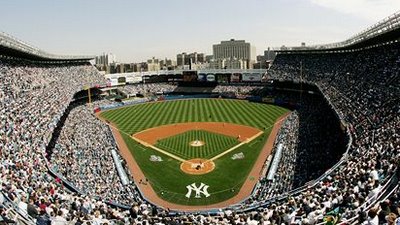
UPDATE: Tigers win 4-3! I really hope the Tigers can knock the Yankees out of the playoffs so I don't have to listen to any more games announced by so-called neutral announcers, who are obviously in love with the Yankees. It's pretty bad when they get more excited about a Derek Jeter popout than a Tigers homerun.
I'd never seen a picture like this of Yankee Stadium, very striking and pleasant to look at.

UPDATE: Tigers win 4-3! I really hope the Tigers can knock the Yankees out of the playoffs so I don't have to listen to any more games announced by so-called neutral announcers, who are obviously in love with the Yankees. It's pretty bad when they get more excited about a Derek Jeter popout than a Tigers homerun.
Sunday, October 01, 2006
The Tigers' Secret Weapon
It's their manager.
Thorgerson has me optimistic that they won't get swept. So now we'll just wait and see.
Thorgerson has me optimistic that they won't get swept. So now we'll just wait and see.




A Piercing Question
From the Bougeois Wife: "How can the Tigers lose three in a row to the Royals and still be playing for the division title?"
From my post on September 7: "There's no way the Tigers will make the playoffs. But if they do make the playoffs, it will be as a wildcard."
In that post, as faithful readers will recall, I gave six indications of the Tigers' demise. Let's see how I did.
(1) Losses to Mariners: The Tigers finished the season on a 10-12 "tear" after the second loss to the Mariners on September 6. Those losses to the Mariners were a sign, and not a good one.
(2) Released Dmitri Young: Okay, maybe he couldn't keep his nose clean.
(3) My fear about playing the Royals: Uncanny.
(4) Carlos Guillen: Well, he came back and is doing well. But he's only one guy, and he doesn't pitch.
(5) Todd Jones is the next Jeff Reardon of 1992: He did okay in today's game against the Royals. But my jury's still out on him. He was, after all, only pitching against the Royals.
(6) Jeremy Bonderman: Is 4-1 since September 7, but gave up four runs in 4.1 innings today (to the Royals).
In short, will the Tigers avoid getting swept by the Yankees? No.
From my post on September 7: "There's no way the Tigers will make the playoffs. But if they do make the playoffs, it will be as a wildcard."
In that post, as faithful readers will recall, I gave six indications of the Tigers' demise. Let's see how I did.
(1) Losses to Mariners: The Tigers finished the season on a 10-12 "tear" after the second loss to the Mariners on September 6. Those losses to the Mariners were a sign, and not a good one.
(2) Released Dmitri Young: Okay, maybe he couldn't keep his nose clean.
(3) My fear about playing the Royals: Uncanny.
(4) Carlos Guillen: Well, he came back and is doing well. But he's only one guy, and he doesn't pitch.
(5) Todd Jones is the next Jeff Reardon of 1992: He did okay in today's game against the Royals. But my jury's still out on him. He was, after all, only pitching against the Royals.
(6) Jeremy Bonderman: Is 4-1 since September 7, but gave up four runs in 4.1 innings today (to the Royals).
In short, will the Tigers avoid getting swept by the Yankees? No.
Thursday, September 28, 2006
Tigers Dodge Bullet
Bad news: Tigers lose to Toronto. First place in central division in jeopardy.
Embarrassing news: Twins lose to Kansas City on the same day.
Good news: Tigers still in first place in central division.
UPDATE: Scratch that. Tigers just shot themselves in foot, and this time Minnesota squeaks by KC.
Embarrassing news: Twins lose to Kansas City on the same day.
Good news: Tigers still in first place in central division.
UPDATE: Scratch that. Tigers just shot themselves in foot, and this time Minnesota squeaks by KC.
Wednesday, September 13, 2006
Saddam's iTunes Playlist
A recent picture from Saddam's trial reveals he's not really paying attention. He's rocking out.

(I think he's beatmatching. His right hand appears to be working one of his turntables.)
This is what's on his playlist:
1. Jimi Hendrix: All Along the Watchtower
2. Johnny Cash: Folsom Prison Blues
3. John Lee Hooker: I'm Prison Bound
4. Otis Redding: Chaingang
5. Jefferson Airplane: No Way Out
6. Grand Funk Railroad: We Gotta Get Out Of This Place
7. Pink Floyd: The Trial
8. Patsy Cline: A Church, A Courtroom, and Then Goodbye
9. Queen Latifah: Court Is In Session
10. Les Miserables Soundtrack: Who Am I? [Saddam apparently likes to shout out "24601" at random moments in his trial.]
11. The Byrds: Life in Prison
12. Eric Clapton: County Jail Blues
13. Wesley Willis: He's Doing Time In Jail
14. Iggy Pop: Little Electric Chair
15. Ice Cube: When I Get To Heaven (from the "Lethal Injection" album)
16. The Cardigans: Hanging Around
And don't forget Rock, Paper, Saddam!

(I think he's beatmatching. His right hand appears to be working one of his turntables.)
This is what's on his playlist:
1. Jimi Hendrix: All Along the Watchtower
2. Johnny Cash: Folsom Prison Blues
3. John Lee Hooker: I'm Prison Bound
4. Otis Redding: Chaingang
5. Jefferson Airplane: No Way Out
6. Grand Funk Railroad: We Gotta Get Out Of This Place
7. Pink Floyd: The Trial
8. Patsy Cline: A Church, A Courtroom, and Then Goodbye
9. Queen Latifah: Court Is In Session
10. Les Miserables Soundtrack: Who Am I? [Saddam apparently likes to shout out "24601" at random moments in his trial.]
11. The Byrds: Life in Prison
12. Eric Clapton: County Jail Blues
13. Wesley Willis: He's Doing Time In Jail
14. Iggy Pop: Little Electric Chair
15. Ice Cube: When I Get To Heaven (from the "Lethal Injection" album)
16. The Cardigans: Hanging Around
And don't forget Rock, Paper, Saddam!
Thursday, September 07, 2006
My Pessimism about Tigers Reaches a Season High
Since August began, I've had that nagging voice in the back of my head: "There's no way the Tigers will make the playoffs." I've kept this to myself until now. I'll just come out and say it: There's no way the Tigers will make the playoffs. But if they do make the playoffs, it will be as a wildcard. Why?
(1) The Tigers just lost two games (at home) to the Mariners, who hadn't won a road game since Reagan was president.
(2) The Tigers released Dmitri Young. What? That guy (if he can keep his nose clean) will be in the hall of fame.
(3) A month ago I was excited about the fact that the Tigers' last nine games of the season are against the Royals (six games) and the Blue Jays (three games). But the Royals recently have taken two of three from the Twins, two of three from the White Sox, and one of three from the Yankees. What's the deal with that? That's respectable. That's not the Kansas City team I've come to know and love.
(4) Carlos Guillen is injured (considered day-to-day).
(5) Todd Jones (you know, the Detroit closer) has a 4.56 ERA. Color me unimpressed. Remember when Jeff Reardon was pitching for the Braves in the 1992 World Series? Everyone said he was supposed to fill their need for a closer. But Ed Sprague took Reardon's fastball for a ride over the leftfield fence to win game two. Todd Jones reminds me of that Jeff Reardon.
(6) Jeremy Bonderman hasn't won a game since July 19.
(1) The Tigers just lost two games (at home) to the Mariners, who hadn't won a road game since Reagan was president.
(2) The Tigers released Dmitri Young. What? That guy (if he can keep his nose clean) will be in the hall of fame.
(3) A month ago I was excited about the fact that the Tigers' last nine games of the season are against the Royals (six games) and the Blue Jays (three games). But the Royals recently have taken two of three from the Twins, two of three from the White Sox, and one of three from the Yankees. What's the deal with that? That's respectable. That's not the Kansas City team I've come to know and love.
(4) Carlos Guillen is injured (considered day-to-day).
(5) Todd Jones (you know, the Detroit closer) has a 4.56 ERA. Color me unimpressed. Remember when Jeff Reardon was pitching for the Braves in the 1992 World Series? Everyone said he was supposed to fill their need for a closer. But Ed Sprague took Reardon's fastball for a ride over the leftfield fence to win game two. Todd Jones reminds me of that Jeff Reardon.
(6) Jeremy Bonderman hasn't won a game since July 19.
Wednesday, September 06, 2006
Rowling on Why It's Good That Voldemort Is So Bad
I have always felt that cardboard baddies make weak heroes and that Harry deserved a really deluxe model, so I have done my best to make Lord Voldemort a real person, red eyed and snakelike though he might be. He, of course, is one of the reasons the Harry Potter books are often banned, but I remain of the firm belief that we need our imaginary villains, the better to brace ourselves for the ones we need to fight in reality.
There are a few other comments from JKR here.
There are a few other comments from JKR here.
Saturday, September 02, 2006
Tigers Lose; I Blame Apollo
Did you see the Tigers-Angels game tonight? Tigers ended up losing in ten innings.
The Tigers were one out away from winning in the ninth, but Izturis reached base on a throwing error by starting shortstop Carlos Guillen and moved to second on an infield single by Cabrera. Vladimir Guerrero then blooped a tying single off Jones, ending his streak of 19 successful save opportunities.
Now why did Guillen miss on what would have been the final throw to first base? There didn't seem to be any reason why that throw should have been wild. But having recently reread the Iliad (Fagles trans.), I suspect some foul play on the part of the gods. Their intervention is quite often noted by Homer, but one of the most blatant ocurrences is in book 16, ll. 914-24:
Then at the fourth assault Patroclus like something superhuman--
then, Patroclus, the end of life came blazing up before you,
yes, the lord Apollo met you there in the heart of battle,
the god, the terror! Patroclus never saw him coming,
moving across the deadly rout, shouded in thick mist
and on he came against him and looming up behind him now--
slammed his broad shoulders and back with the god's flat hand
and his eyes spun as Apollo knocked the helmet off his head
and under his horses' hoofs it tumbled, clattering on
with its four forged horns and its hollow blank eyes
and its plumes were all smeared in the bloody dust.
Just so, Apollo must be an Angels' fan to descend to give such a heavy blow to the unsuspecting Guillen. (And later in the game, Guillen injured "himself" running out a double; or was his injury also due to Apollo? Did Guillen somehow offend the lord of the silver bow?)
The Tigers were one out away from winning in the ninth, but Izturis reached base on a throwing error by starting shortstop Carlos Guillen and moved to second on an infield single by Cabrera. Vladimir Guerrero then blooped a tying single off Jones, ending his streak of 19 successful save opportunities.
Now why did Guillen miss on what would have been the final throw to first base? There didn't seem to be any reason why that throw should have been wild. But having recently reread the Iliad (Fagles trans.), I suspect some foul play on the part of the gods. Their intervention is quite often noted by Homer, but one of the most blatant ocurrences is in book 16, ll. 914-24:
Then at the fourth assault Patroclus like something superhuman--
then, Patroclus, the end of life came blazing up before you,
yes, the lord Apollo met you there in the heart of battle,
the god, the terror! Patroclus never saw him coming,
moving across the deadly rout, shouded in thick mist
and on he came against him and looming up behind him now--
slammed his broad shoulders and back with the god's flat hand
and his eyes spun as Apollo knocked the helmet off his head
and under his horses' hoofs it tumbled, clattering on
with its four forged horns and its hollow blank eyes
and its plumes were all smeared in the bloody dust.
Just so, Apollo must be an Angels' fan to descend to give such a heavy blow to the unsuspecting Guillen. (And later in the game, Guillen injured "himself" running out a double; or was his injury also due to Apollo? Did Guillen somehow offend the lord of the silver bow?)
Thursday, August 17, 2006
More Baseball
This time from Bill Simmons, on who's likely to win the World Series. I love the opening:
Not only has the National League transformed into Quadruple-A, as far as I can tell the Dodgers and Mets are the only two NL teams capable of doing anything in October. And by "anything," I mean not "getting swept in the World Series."
Not only has the National League transformed into Quadruple-A, as far as I can tell the Dodgers and Mets are the only two NL teams capable of doing anything in October. And by "anything," I mean not "getting swept in the World Series."
Friday, August 04, 2006
Wouldn't This Be a Great Job?
This may sound strange to some of you, but I think this would be a great thing to do for work.
Wednesday, August 02, 2006
Meno 72b-d
I started my translation of this dialogue a while ago. I've already posted some of it here, here, and here. Here's the next installment.
Socrates: Indeed, I seem to have furnished myself with some great fortune, Meno, if by my inquiring into virtue I have discovered some beehive of virtues lying near you. But, Meno, going with this image about the beehive, if after I asked about a bee, concerning [its] being (ousia), [b] what it is (pot’ estin), you said them1 to be of many and of all kinds, what would you answer me, if I asked you, "Are you declaring there to be many, of all kinds, and different from one another? Or in this2 do they differ in nothing, but [they differ] with respect to other things -- beauty or size or another of these things?" Speak, how would you answer having been asked?
Meno: I would say this, that they differ in nothing (they are bees) the one from the other.3
[c] Socrates: If then I were to say after that, "Now tell me just this, Meno: By what4 do they differ in nothing but are entirely (apasai) identical (tauton)? What do you declare this to be?" You'd have, perhaps, something to tell me?
Meno: Indeed.
Socrates: Thus indeed, concerning virtues, too. Even if they are many and all kinds, they have some form (eidov) entirely (apasai) identical (tauton) by which they are virtues, by which perhaps the person answering, having looked to [it] beautifully, is to make visible to the one asking what he hit upon [namely,] [d] the being of virtue. Or do you not understand (manqaneiv) what I’m saying?
Notes
1. autav: pl. fem. acc; the plural number is a bit odd because Socrates (in answering his own question!) began with the singular (a bee) and switches to plural (themselves, them). But note that if Socrates had been consistent in his number, his question either would not be coherent ("if I asked you about a bee, would you say it is of many and all kinds?") or as clear ("if I asked you about bees, would you say they are many and of all kinds?").
2. toutwi: sing. masc. dat, the antecedent is unclear; is it ousia? To back up a little, Socrates says, "if I asked you to tell me about the being of a bee, and you said they (see note 1) were all different, then I might ask you if you meant they were all different, but they are not different in this but in some other way." What is Socrates referring to when he says "in this"? Or is there no direct antecedent?
3. This translation is awkward. Most translators opt to treat the phrase hi melittai eisin playing the role of "qua bees." But that seems to be add too much to the text; this is, after all, Meno’s speech, and I am not convinced he has grasped the concept expressed by "qua."
4. Sing. masc. dat. of ov, taken in an instrumental way; note the singular number corresponds to the second question What do you declare this to be? Not to lean on the grammar too much, but already it is clear Socrates is looking for one thing in virtue of which the same things are all alike.
Socrates: Indeed, I seem to have furnished myself with some great fortune, Meno, if by my inquiring into virtue I have discovered some beehive of virtues lying near you. But, Meno, going with this image about the beehive, if after I asked about a bee, concerning [its] being (ousia), [b] what it is (pot’ estin), you said them1 to be of many and of all kinds, what would you answer me, if I asked you, "Are you declaring there to be many, of all kinds, and different from one another? Or in this2 do they differ in nothing, but [they differ] with respect to other things -- beauty or size or another of these things?" Speak, how would you answer having been asked?
Meno: I would say this, that they differ in nothing (they are bees) the one from the other.3
[c] Socrates: If then I were to say after that, "Now tell me just this, Meno: By what4 do they differ in nothing but are entirely (apasai) identical (tauton)? What do you declare this to be?" You'd have, perhaps, something to tell me?
Meno: Indeed.
Socrates: Thus indeed, concerning virtues, too. Even if they are many and all kinds, they have some form (eidov) entirely (apasai) identical (tauton) by which they are virtues, by which perhaps the person answering, having looked to [it] beautifully, is to make visible to the one asking what he hit upon [namely,] [d] the being of virtue. Or do you not understand (manqaneiv) what I’m saying?
Notes
1. autav: pl. fem. acc; the plural number is a bit odd because Socrates (in answering his own question!) began with the singular (a bee) and switches to plural (themselves, them). But note that if Socrates had been consistent in his number, his question either would not be coherent ("if I asked you about a bee, would you say it is of many and all kinds?") or as clear ("if I asked you about bees, would you say they are many and of all kinds?").
2. toutwi: sing. masc. dat, the antecedent is unclear; is it ousia? To back up a little, Socrates says, "if I asked you to tell me about the being of a bee, and you said they (see note 1) were all different, then I might ask you if you meant they were all different, but they are not different in this but in some other way." What is Socrates referring to when he says "in this"? Or is there no direct antecedent?
3. This translation is awkward. Most translators opt to treat the phrase hi melittai eisin playing the role of "qua bees." But that seems to be add too much to the text; this is, after all, Meno’s speech, and I am not convinced he has grasped the concept expressed by "qua."
4. Sing. masc. dat. of ov, taken in an instrumental way; note the singular number corresponds to the second question What do you declare this to be? Not to lean on the grammar too much, but already it is clear Socrates is looking for one thing in virtue of which the same things are all alike.
With Friends Like Johannes Myronas . . .
Scientists finally uncover, using x-rays, lost texts of Archimedes. (Go, Science, go!) They had been painted over by a monk in Jerusalem, Johannes Myronas, so that he could write down more prayers. (I'm sure there's a metaphor for history or culture in that: "You see, the prayers of the religious are written over science. . ." or "In the actions of Johannes Myronas we see once again the hegemonic desire of 'orthodoxy' as it (literally) effaces what to it is the obscene writing of an 'other' embodying the unembodied mathematics of difference, etc. etc. ad nauseam . . . .")
Thanks a lot, Johannes. Couldn't you have at least scribbled out something more uselesss? Aristotle, for example? Or maybe that pesky gospel of Judas?
Thanks a lot, Johannes. Couldn't you have at least scribbled out something more uselesss? Aristotle, for example? Or maybe that pesky gospel of Judas?
Warning: Don't Click if You've Got Work to Do
I've been playing this game from Dyson. I've finished all the regular levels, grandmaster levels, block levels, and half of the Christmas levels. I've also worked out a few of the transporter levels. (Of course, I should be studying.)
My interest in the game was sparked by a recent purchase for which I plunked down all the pennies I'd been saving for a Dyson vacuum. I mean, I was really saving, a, lot, of, pennies: I haven't bought a new (or used) book in a long time. And it was only made possible by a sale at Best Buy.
Now I love to vacuum (seriously), and it actually gets the carpets clean (behold the power of the Dyson 07 "Animal.")
When I was a tyke, it was my job to vacuum, and I hated it. Sometimes when mom asked me to vacuum, I just took the vacuum in the bedroom and turned it on for a few minutes. I always wondered how mom could tell that I hadn't actually moved the vacuum around. Perhaps it was all the stuff on the floor that is invisible to the eyes of little boys.
My interest in the game was sparked by a recent purchase for which I plunked down all the pennies I'd been saving for a Dyson vacuum. I mean, I was really saving, a, lot, of, pennies: I haven't bought a new (or used) book in a long time. And it was only made possible by a sale at Best Buy.
Now I love to vacuum (seriously), and it actually gets the carpets clean (behold the power of the Dyson 07 "Animal.")
When I was a tyke, it was my job to vacuum, and I hated it. Sometimes when mom asked me to vacuum, I just took the vacuum in the bedroom and turned it on for a few minutes. I always wondered how mom could tell that I hadn't actually moved the vacuum around. Perhaps it was all the stuff on the floor that is invisible to the eyes of little boys.
Thursday, July 27, 2006
Dalrymple on Zidane
Theodore Dalrymple comments on reactions to Zidane's head-butt (such an ugly word) in the World Cup final.
On Writing
Joseph Pieper says in his book Enthusiasm and Divine Madness, on the Phaedrus of Plato,
The very great teachers do not write. Few will guess that this . . . sentence is an almost literal quotation from the Summa theologica of Thomas Aquinas, who specifically mentions Socrates in connection with this statement. Thomas asks whether Christ should not have set down his doctrine in writing -- and answers that the higher mode of teaching is proper to the greater teacher, and that that higher mode consists in impressing his doctrine upon the hearts of his hearers. (101)
The very great teachers do not write. Few will guess that this . . . sentence is an almost literal quotation from the Summa theologica of Thomas Aquinas, who specifically mentions Socrates in connection with this statement. Thomas asks whether Christ should not have set down his doctrine in writing -- and answers that the higher mode of teaching is proper to the greater teacher, and that that higher mode consists in impressing his doctrine upon the hearts of his hearers. (101)
Monday, July 10, 2006
Zidane?

Everyone wants to know what was said.
Of course, the King's ignominous act cannot be forgotten either, but in the case of Cantona, he seemed to learn something from his suspension and found some redemption when he returned to play. What is Zidane to learn from this, for he will never return to play?
Wednesday, July 05, 2006
Zidane!

I'll always be partial to the King, but Zidane is my new French soccer hero. He even has a flashy Web page.

UPDATE: a great picture of Zidane's penalty kick against Portugal.
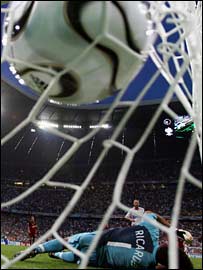
Friday, June 30, 2006
On Rhetoric
For the record, Fonseca Bin no. 27 is my favorite annual port (meaning it is produced every year and so is widely available ... truly high quality sweet wines are only produced when the grapes are just right and so are unpredictable).
A good friend thoughtfully gave me the Loeb with Plato's Symposium, Lysis and Gorgias for summer reading, and I have decided to work through Gorgias. If I keep an average pace of about 15 pages per week I should easily finish during the summer. I'll post comments here to keep myself accountable (cough).
As an opener: So far, Mr. W.R.M. Lamb ("sometime fellow of Trinity College, Cambridge") seems to have been an ironic choice to translate the dialogue on rhetoric, for his translation robs the speakers of some of their best demonstrations of wit. This is so important because Gorgias is the supreme rhetorician whose craft, as Socrates will demonstrate, has nothing to do with true knowledge and so is not a craft at all; besides, as we shall see, Socrates is better at it than everyone else.
Very Beginning (my own):
Kallikles: As they say, Socrates, you desire a war and battle so as to get a share (ie., just to get the spoils).
Socrates: Rather do you mean the saying, we have come too late for the feast?
K: Indeed and a most urbane feast. For just a moment ago Gorgias put on a varied and beautiful display for us.
S: Chaipheron here is to blame, having forced us to spend our time in the market place.
Get it? Kallikles has just listened to a display of rhetoric, but has learned nothing (because rhetoric has nothing true to teach) since he immediately proceeds to quote a useless proverb at his new quests. Kallikles calls the feast urbane; Socrates puns on the word complaining that he was stuck in the market (ie., the center of the city). Who's the rhetorician now? Who's the true teacher: the one at a feast giving a self congratulatory display of words at a posh dinner or the one in the market place with his students? Ta da, the themes of the dialogue summarized and proven in the first four lines. All of this is missed in Lamb's translation thanks to his unimaginative diction.
A good friend thoughtfully gave me the Loeb with Plato's Symposium, Lysis and Gorgias for summer reading, and I have decided to work through Gorgias. If I keep an average pace of about 15 pages per week I should easily finish during the summer. I'll post comments here to keep myself accountable (cough).
As an opener: So far, Mr. W.R.M. Lamb ("sometime fellow of Trinity College, Cambridge") seems to have been an ironic choice to translate the dialogue on rhetoric, for his translation robs the speakers of some of their best demonstrations of wit. This is so important because Gorgias is the supreme rhetorician whose craft, as Socrates will demonstrate, has nothing to do with true knowledge and so is not a craft at all; besides, as we shall see, Socrates is better at it than everyone else.
Very Beginning (my own):
Kallikles: As they say, Socrates, you desire a war and battle so as to get a share (ie., just to get the spoils).
Socrates: Rather do you mean the saying, we have come too late for the feast?
K: Indeed and a most urbane feast. For just a moment ago Gorgias put on a varied and beautiful display for us.
S: Chaipheron here is to blame, having forced us to spend our time in the market place.
Get it? Kallikles has just listened to a display of rhetoric, but has learned nothing (because rhetoric has nothing true to teach) since he immediately proceeds to quote a useless proverb at his new quests. Kallikles calls the feast urbane; Socrates puns on the word complaining that he was stuck in the market (ie., the center of the city). Who's the rhetorician now? Who's the true teacher: the one at a feast giving a self congratulatory display of words at a posh dinner or the one in the market place with his students? Ta da, the themes of the dialogue summarized and proven in the first four lines. All of this is missed in Lamb's translation thanks to his unimaginative diction.
Thursday, June 29, 2006
Thoughts on JKR
(1) Rowling said recently that two characters will die in the final Harry Potter novel. All fine and good. I want to know if any of them will come back to life.
(2) While reading Plato's Phaedrus to prepare to lead some discussions on it, I came across this passage:
For the prophetess in Delphi and the priestesses in Dodona when mad have accomplished many beautiful things for Greece both in private and in public, but little, or rather nothing, when of sound mind. And if we should speak of the Sibyl and others, who used divinely inspired prophesy to foretell in the future many things to many people and guide them aright, we would draw it [our speech] out at length, saying things that are clear to everyone. (244a-b, trans. Nichols)
Is this description not a deadringer for Trelawny? What was her first name again? Sibyl? I also wonder if Trelawny's penchant for sherry is based on her desire to lose herself in something other than herself so that she may prophesy. For she does not prophesy under her own power, but only when influenced by . . . ? What? God?
I've thought for a while now that the only thing in Harry Potter's world that is truly supernatural is prophecy. What about the magic, you say? Two things about the magic make it not so easily supernatural: it has to be learned by great study (that is why the students are at Hogwarts) and a fully developed natural science would be indistinguishable from magic. (Here I could throw in some quotation from Lewis's Abolition of Man about how magic and science both spring from the same desire, but you already know all that. But consider anyway this article describing how scientists will probably make something like Harry's invisibility cloak.)
John Granger has written a wonderful article on Harry Potter. Everyone should read it, especially critics. Among other things, the article points out in various places the tenuous nature of our understanding of the distinction between natural and supernatural. What is it to be supernatural? Is alchemy natural or not?
One thing I would add to his article is a mention of the existence of prophecy in the books. I think it is one of the clearest indicators Rowling's world is supernatural. And immersing ourselves in that world is indeed a powerful ally in helping us to live "fully human, which is to say 'spiritual,' lives" (Granger, last para.).
(2) While reading Plato's Phaedrus to prepare to lead some discussions on it, I came across this passage:
For the prophetess in Delphi and the priestesses in Dodona when mad have accomplished many beautiful things for Greece both in private and in public, but little, or rather nothing, when of sound mind. And if we should speak of the Sibyl and others, who used divinely inspired prophesy to foretell in the future many things to many people and guide them aright, we would draw it [our speech] out at length, saying things that are clear to everyone. (244a-b, trans. Nichols)
Is this description not a deadringer for Trelawny? What was her first name again? Sibyl? I also wonder if Trelawny's penchant for sherry is based on her desire to lose herself in something other than herself so that she may prophesy. For she does not prophesy under her own power, but only when influenced by . . . ? What? God?
I've thought for a while now that the only thing in Harry Potter's world that is truly supernatural is prophecy. What about the magic, you say? Two things about the magic make it not so easily supernatural: it has to be learned by great study (that is why the students are at Hogwarts) and a fully developed natural science would be indistinguishable from magic. (Here I could throw in some quotation from Lewis's Abolition of Man about how magic and science both spring from the same desire, but you already know all that. But consider anyway this article describing how scientists will probably make something like Harry's invisibility cloak.)
John Granger has written a wonderful article on Harry Potter. Everyone should read it, especially critics. Among other things, the article points out in various places the tenuous nature of our understanding of the distinction between natural and supernatural. What is it to be supernatural? Is alchemy natural or not?
One thing I would add to his article is a mention of the existence of prophecy in the books. I think it is one of the clearest indicators Rowling's world is supernatural. And immersing ourselves in that world is indeed a powerful ally in helping us to live "fully human, which is to say 'spiritual,' lives" (Granger, last para.).
Thursday, June 15, 2006
My New Pastime
Listening to the Dan Patrick Show on ESPN Radio. I grew up watching and playing sports, but I've drifted from those roots (mixed metaphor, I know) in the last ten years or so. But now I'm moving back to more sports.
The Dan Patrick show is on during the time when I drive back home from teaching a summer school class in logic. At first, I just listened because the long pauses between his sentences made me think something was wrong with my radio. Then I loved the fact that when people call in to the show, they give their height and weight.
What I like about the DPS is that it's not just about sports for sports' sake. I mean, he isn't talking about who's the greatest running back of all time. The last two days have covered interesting ethical issues.
(1) Does Ben Roethlisberger have a duty (obligation) to wear a motorcycle helmet?
(2) Was it immoral for Ozzie Guillen to tell his rookie pitcher, Sean Tracey, to hit Hank Blalock? And then was Tracey justified in not hitting Blalock? And was Guillen justified in demoting Tracey to triple-A ball for not hitting Blalock?
I'll actually discuss what I think are the relevant issues in (2) later.
The Dan Patrick show is on during the time when I drive back home from teaching a summer school class in logic. At first, I just listened because the long pauses between his sentences made me think something was wrong with my radio. Then I loved the fact that when people call in to the show, they give their height and weight.
What I like about the DPS is that it's not just about sports for sports' sake. I mean, he isn't talking about who's the greatest running back of all time. The last two days have covered interesting ethical issues.
(1) Does Ben Roethlisberger have a duty (obligation) to wear a motorcycle helmet?
(2) Was it immoral for Ozzie Guillen to tell his rookie pitcher, Sean Tracey, to hit Hank Blalock? And then was Tracey justified in not hitting Blalock? And was Guillen justified in demoting Tracey to triple-A ball for not hitting Blalock?
I'll actually discuss what I think are the relevant issues in (2) later.
Thursday, June 08, 2006
About Time
The Tigers beat the White Sox (for the first time this season) to hold on to first place and the best record in the league.
Five Best Mystery Novels
Glad to see that DLS makes the cut, though it's not the one I would have chosen. Rather surprised that there's nothing from Agatha Christie, though perhaps the designation "crime novel" rules her out. Perhaps she's good at crime, but not so good at novels. Same for Doyle.
Sunday, June 04, 2006
Wednesday, May 31, 2006
Remember that Case about the Evolution Sticker in Georgia?
It's back.
A federal appeals court essentially told the judge who made the ruling that there are problems with the evidentiary record.
. . . in determining that the sticker unconstitutionally advanced religion, the lower court judge said the school board had considered placing the disclaimer on textbooks after receiving a petition signed by 2,300 local residents. But, according to the appeals court, no such petition appears in the evidentiary record.
A federal appeals court essentially told the judge who made the ruling that there are problems with the evidentiary record.
. . . in determining that the sticker unconstitutionally advanced religion, the lower court judge said the school board had considered placing the disclaimer on textbooks after receiving a petition signed by 2,300 local residents. But, according to the appeals court, no such petition appears in the evidentiary record.
Wednesday, May 24, 2006
Eighteen Volts of Manliness
I am now the proud owner of this:

When I went to the store to buy a drill, I was only thinking of getting the 14.4 volt one, which is all I (the Southern California apartment-dweller) really need. But then the 18 volt was on sale and only $10 more: an extra 3.6 volts for only $10? Sign me up!

When I went to the store to buy a drill, I was only thinking of getting the 14.4 volt one, which is all I (the Southern California apartment-dweller) really need. But then the 18 volt was on sale and only $10 more: an extra 3.6 volts for only $10? Sign me up!
Thursday, May 18, 2006
Ouch!
From Doug TenNapel:
"Poorly written, poor Bible scholarship, made for Americans ignorant of the most basic Christian principles; are we talking about DaVinvi Code or Purpose Driven Life?"
"Poorly written, poor Bible scholarship, made for Americans ignorant of the most basic Christian principles; are we talking about DaVinvi Code or Purpose Driven Life?"
Wednesday, May 17, 2006
Always Look on the Bright Side of Life
While munching on a lonely dinner I visited John Cleese's web site, where you can watch the great man explain why it just makes sense to believe the founders of religions were esoteric (read: intentionally not making sense). Not that Python is where I would like to expend my thinking energy, but the popular idea (I at least hear it a lot arount here) of mystics being incapable of communicating in a "literal minded way" just doesn't fit when you actually study mystics. Sure, you have people who just say and do really weird stuff (in my studies, Symeon Stylites, Symeon the Holy Fool). However, this picture is the product of our lack of evidence of Late Antiquity and does not mean that the utterances of mystics are or were beyond intelligent interpretation, or that they even intended them to be such. (see Michael Dols, Majnun: The Madman in the Medieval Islamic World or Sergei A. Ivanov's Holy Fools in Byzantium and Beyond who elsewhere argues that in imperial Russia these holy mystics speak the same "language" as the Tsars, but that is a whole different debate.)
The extremely popular (available in any Borders) Jelaluddin Rumi, the 13th century Anatolian mystic who is one of the figures that people like Cleese most latch onto is one I am studying. The reason you can think people like this are not understandable in the most basic sense is because you are reading one-page selections of their strangest poetry and sayings in your highly illustrated coffee-table volume. It annoys me because the underlying assumption is that these people were supra-moral, supra-political, supra-social, etc.. Whereas in reality all of the founders save one of the 13th century mystical movements that I am studying (both Christian and Sufi) were explicitly politically involved, and a huge percentage of that remaining one's disciples were political figures, so either they all didn't "get it" or Cleese isn't "getting it". In any case, all of them were quite willing and capable of explaining things in rational statement about God when they wanted to.
The basic argument for Cleese seems to be: God is That-Which-Is-Unexplainable. Mystics experience God. Mystics can only express their experience of Unexplainable by being inexplicable. The thing is, they aren't. If they do want to be non-sensical, they only want to be so to "the uniniated", so they explain things in ways that only their disciples can understand. I think this is obvious and it is not worth belaboring the point.
There is, to be fair, a very true idea at the core of the Cleese-doctrine. It is impossible to positively explain the experience of a relationship. But I don't think it is limited to God-relationships at all. Try to explain in positive statement to anyone what it is is to love your lover and you'll soon be stuck as well. However, contra-Cleese, this does not mean that those who experience God cannot communicate about God, or that God cannot communicate about Himself. This is why we use negative statement and metaphors -- not to render ourselves inexplicable, but because they actually explain more.
What I can't figure out is why people like Cleese stick to this goofy line so fervently. To me it seems a) uninteresting and unstimulating, because you have backed yourself into a position where to actually say anything begs the question and b) strikes me as an excuse to keep doing whatever it is that you do unless you happen to be hit by the Unexplainable, which is highly unlikely, since we like to think of mystics (and their God) staying on The Mountain (or on our bookshelf in the "Multi-Faith Chapel of JC"). To come full circle, this is the irony of the site, which is dedicated to John Cleese unashamedly marketing every bit of himself (see the Ring Tones page) and his California Ranch so he can keep collecting Lemurs and Gyneth-Paltrow-the-Emus.*
*None of this changes the fact that Monty Python is the best comedy group of the Modern Era and will continue to make me giggle.
The extremely popular (available in any Borders) Jelaluddin Rumi, the 13th century Anatolian mystic who is one of the figures that people like Cleese most latch onto is one I am studying. The reason you can think people like this are not understandable in the most basic sense is because you are reading one-page selections of their strangest poetry and sayings in your highly illustrated coffee-table volume. It annoys me because the underlying assumption is that these people were supra-moral, supra-political, supra-social, etc.. Whereas in reality all of the founders save one of the 13th century mystical movements that I am studying (both Christian and Sufi) were explicitly politically involved, and a huge percentage of that remaining one's disciples were political figures, so either they all didn't "get it" or Cleese isn't "getting it". In any case, all of them were quite willing and capable of explaining things in rational statement about God when they wanted to.
The basic argument for Cleese seems to be: God is That-Which-Is-Unexplainable. Mystics experience God. Mystics can only express their experience of Unexplainable by being inexplicable. The thing is, they aren't. If they do want to be non-sensical, they only want to be so to "the uniniated", so they explain things in ways that only their disciples can understand. I think this is obvious and it is not worth belaboring the point.
There is, to be fair, a very true idea at the core of the Cleese-doctrine. It is impossible to positively explain the experience of a relationship. But I don't think it is limited to God-relationships at all. Try to explain in positive statement to anyone what it is is to love your lover and you'll soon be stuck as well. However, contra-Cleese, this does not mean that those who experience God cannot communicate about God, or that God cannot communicate about Himself. This is why we use negative statement and metaphors -- not to render ourselves inexplicable, but because they actually explain more.
What I can't figure out is why people like Cleese stick to this goofy line so fervently. To me it seems a) uninteresting and unstimulating, because you have backed yourself into a position where to actually say anything begs the question and b) strikes me as an excuse to keep doing whatever it is that you do unless you happen to be hit by the Unexplainable, which is highly unlikely, since we like to think of mystics (and their God) staying on The Mountain (or on our bookshelf in the "Multi-Faith Chapel of JC"). To come full circle, this is the irony of the site, which is dedicated to John Cleese unashamedly marketing every bit of himself (see the Ring Tones page) and his California Ranch so he can keep collecting Lemurs and Gyneth-Paltrow-the-Emus.*
*None of this changes the fact that Monty Python is the best comedy group of the Modern Era and will continue to make me giggle.
Monday, May 15, 2006
Rest in Peace, Dr. Pelikan
Jaroslav Pelikan died Saturday of lung cancer. He wrote what is certainly the best history of Christian doctrine published in the last hundred years. He gives one reason (among others) why he wrote it:
For those who believe that you don't need tradition because you have the Bible, the Christian Tradition has sought to say, "You are not entitled to the beliefs you cherish about such things as the Holy Trinity without a sense of what you owe to those who worked this out for you." To circumvent Saint Athanasius on the assumption that if you put me alone in a room with the New Testament, I will come up with the doctrine of the Trinity, is naive. So for these readers I have tried to provide a degree of historical sophistication, which is, I believe, compatible with an affirmation of the central doctrines of Christian faith.
A devout Lutheran for much of his life, he was received into the Orthodox Church in America in 1998. May his soul, and the souls of all the faithful departed, through the mercy of God, rest in peace.
For those who believe that you don't need tradition because you have the Bible, the Christian Tradition has sought to say, "You are not entitled to the beliefs you cherish about such things as the Holy Trinity without a sense of what you owe to those who worked this out for you." To circumvent Saint Athanasius on the assumption that if you put me alone in a room with the New Testament, I will come up with the doctrine of the Trinity, is naive. So for these readers I have tried to provide a degree of historical sophistication, which is, I believe, compatible with an affirmation of the central doctrines of Christian faith.
A devout Lutheran for much of his life, he was received into the Orthodox Church in America in 1998. May his soul, and the souls of all the faithful departed, through the mercy of God, rest in peace.
Friday, May 12, 2006
New Book on Tolkien and the OED
Details are here. It looks quite good.
A while ago, I searched the online OED for illustrations of word usage drawn from Tolkien. There were about 150, which for someone who isn't Shakespeare is quite a good number. And hobbit is in the OED.
He also has his own adjectives: Tolkienian and Tolkienesque.
I still maintain the best book yet written on Tolkien (though I haven't yet read the one mentioned above) is by Tom Shippey (J.R.R. Tolkien: Author of the Century).
By the way, for those who don't know (for a long time I didn't): OED stands for Oxford English Dictionary. If you want to buy my friendship, a good start would be with a copy of the OED. Of course, if you look up friendship in the OED, the first example is from Beowulf.
A while ago, I searched the online OED for illustrations of word usage drawn from Tolkien. There were about 150, which for someone who isn't Shakespeare is quite a good number. And hobbit is in the OED.
He also has his own adjectives: Tolkienian and Tolkienesque.
I still maintain the best book yet written on Tolkien (though I haven't yet read the one mentioned above) is by Tom Shippey (J.R.R. Tolkien: Author of the Century).
By the way, for those who don't know (for a long time I didn't): OED stands for Oxford English Dictionary. If you want to buy my friendship, a good start would be with a copy of the OED. Of course, if you look up friendship in the OED, the first example is from Beowulf.
Thursday, May 11, 2006
In Which I Answer a Pressing Question
(If you haven't read Harry Potter and the Half-Blood Prince and don't want the story ruined, don't read on.)
The Leaky Cauldron has a list of questions left to be answered in the seventh book. One of them is "How does one destroy a Horcrux, anyway?"
I'd have thought that one was obvious: Stab it with a basilisk fang.
The Leaky Cauldron has a list of questions left to be answered in the seventh book. One of them is "How does one destroy a Horcrux, anyway?"
I'd have thought that one was obvious: Stab it with a basilisk fang.
Tuesday, May 09, 2006
You Know It's Not Going to Be a Good Neil Young Album . . .
. . . when reviewers preface their comments with "While this is not as bad as Landing on Water . . . ."
Wednesday, May 03, 2006
In Which I Am Amazed by the Success of the Detroit Tigers
They're only a half game out of first place. The pessimist in me predicts they will fall below .500 by the end of the season. (By the way, Thorgerson, in case you missed it, the Tigers clobbered the Twins a while back.)
UPDATE: Of course, the day after I post this, the Tigers get spanked by the Angels, 7-2.
UPDATE: Of course, the day after I post this, the Tigers get spanked by the Angels, 7-2.
Wednesday, April 26, 2006
In Which I Pose a Fairly Easy Question from Alcuin, the Monk
Alcuin was head teacher in the palace school of Charlemagne at Aachen. Here is one of the questions in his Propositiones ad acuendos iuvenes:
An ox plows all day long. How many tracks does he leave in the last furrow?
For the answer, click "Read More."
Answer: None. The plow removes them all.
(HT: Percival Blakney Academy)
An ox plows all day long. How many tracks does he leave in the last furrow?
For the answer, click "Read More."
Answer: None. The plow removes them all.
(HT: Percival Blakney Academy)
Tuesday, April 25, 2006
In Which I Help You Understand Why Gas Prices Are So High
Read this short piece by Lynne Kiesling of the fine economics blog "Knowledge Problem."
Doing Bad vs. Being Bad
From Aristotle (Nicomachean Ethics, 1151a6-11 [trans. Joe Sachs]):
It is clear then that unrestraint is not vice . . . since the one [dissipation] is by choice and the other [unrestraint] is contrary to choice; however, they are alike as far as actions are concerned, as with the words of Demodocus to the Milesians, "It's not that Milesians are stupid, just that they will do the sort of things that stupid people do"; and while unrestrained people are not unjust, they will do injustice.
It is clear then that unrestraint is not vice . . . since the one [dissipation] is by choice and the other [unrestraint] is contrary to choice; however, they are alike as far as actions are concerned, as with the words of Demodocus to the Milesians, "It's not that Milesians are stupid, just that they will do the sort of things that stupid people do"; and while unrestrained people are not unjust, they will do injustice.
Monday, April 03, 2006
The Frothier Side of Life

Still on just my third brew, I think this will be the first truly enjoyable to drink (I'm just being honest).
The recipe: Thorgersen's Nut Brown Ale
Inspired by Byron Burch, Brewing Quality Beers, 2nd ed., 1992
6 lbs. Light Liquid Barley Malt Extract, Extra Malty
9 oz. Carmel 20 Barley
4.5 oz. Chocolate Barley
(Crush and cook barley)
1/4 t salt
2 oz. Malto Dexterin
2 oz. Nugget bittering hops (cook 1 oz. 60 minutes, 1 oz. 30 minutes)
1 oz. Willamette aromatic hops (cook 8 minutes)
English Ale Liquid Yeast
The picture is after a little more than a day of fermenting, and is a much better head than I've ever got before. The batch should make around 50 bottles, and at about 30-35 dollars for ingredients, this figures to be quite the hobby. If everything turns out I'm going to try a fruit ale next (ahem, for the Mrs.).
Wednesday, March 29, 2006
It (Sort of) Makes Sense When You Think about It
Biola University, a conservative evangelical university in southern California, is giving its Phillip E. Johnson Award for Liberty and Truth to Antony Flew, one of the staunchest defenders of atheism in the past century. Of course, Flew is no longer an atheist.
I recall some people mocking Biola last year for giving the Phillip E. Johnson award to (who else?) Phillip E. Johnson. I wonder if those people will mock this year. Seriously. Would they claim that Biola is just giving the award to Flew because he converted from atheism (in part because of things like intelligent design -- read the interview in which he discusses this)? Would Biola have given the award to Flew even if he were still an atheist?
I recall some people mocking Biola last year for giving the Phillip E. Johnson award to (who else?) Phillip E. Johnson. I wonder if those people will mock this year. Seriously. Would they claim that Biola is just giving the award to Flew because he converted from atheism (in part because of things like intelligent design -- read the interview in which he discusses this)? Would Biola have given the award to Flew even if he were still an atheist?
Monday, March 27, 2006
In Which I Wonder if Rowling Alludes to Socrates
In Harry Potter and the Order of the Phoenix, Rowling introduces the character of Luna Lovegood. Luna is loony but proves to be a good friend to Harry, Ron, and Hermione. Her father publishes a newspaper called The Quibbler, which ends up playing an important role in the story: It is the vehicle by which an important truth is made known. However, it is maligned throughout the novel for its reputation for printing pointless conspiracy theories and other nonsense; in short, for quibbling instead of employing words for more serious matters, like the oh-so-serious Daily Prophet. (OED's first definition of "quibble" is "to pun, to play on words.")
In Aristophanes' play Frogs, we find the following description of Socrates:
So it is refined not by Socrates
to sit and chatter
casting aside the pursuits of the Muses
and neglecting what's most important
in the art of tragedy.
But to spend time idly
in pompous words
and frivolous word-scraping
is the act of a man going crazy.
(trans. Dillon)
Here we have the perfect description of a quibbler. (Klein, in his commentary on the Meno, actually refers to Socrates in the Aristophanes passage as a quibbler.) Aristophanes -- who was at least not bosom buddies with Socrates -- describes Socrates as engaging in idle chatter. But if we take Plato's word, Socrates was not interested in chatter but in seeking the truth. Of course, it is easy to see how Socrates, who was always talking (discussing), could be mistaken for a word-scraper, or, in general, how one who seeks (even dispenses) the truth by conversing with others could be mistaken for a quibbler.
(I hope I need not remind my readers that Rowling has a degree in classics.)
In Aristophanes' play Frogs, we find the following description of Socrates:
So it is refined not by Socrates
to sit and chatter
casting aside the pursuits of the Muses
and neglecting what's most important
in the art of tragedy.
But to spend time idly
in pompous words
and frivolous word-scraping
is the act of a man going crazy.
(trans. Dillon)
Here we have the perfect description of a quibbler. (Klein, in his commentary on the Meno, actually refers to Socrates in the Aristophanes passage as a quibbler.) Aristophanes -- who was at least not bosom buddies with Socrates -- describes Socrates as engaging in idle chatter. But if we take Plato's word, Socrates was not interested in chatter but in seeking the truth. Of course, it is easy to see how Socrates, who was always talking (discussing), could be mistaken for a word-scraper, or, in general, how one who seeks (even dispenses) the truth by conversing with others could be mistaken for a quibbler.
(I hope I need not remind my readers that Rowling has a degree in classics.)
Saturday, March 25, 2006
In Which I Guess that All the Harry Potter Novels So Far Lead Up to This Speech by Dumbledore about Voldemort
". . . he was in such a hurry to mutilate his own soul, he never paused to understand the incomparable power of a soul that is untarnished and whole" (Harry Potter and the Half-Blood Prince, p. 511).
Rowling's genius has now exposed millions of people all over the world to this beautiful idea.
Rowling's genius has now exposed millions of people all over the world to this beautiful idea.
Friday, March 24, 2006
It's Like They're Animals
Our cats. I woke up this morning to find that one of them (Rosemary, I'm looking in your direction) had vomitted all over a placemat on the table. I left it just in case the culprit wanted to have it later for a snack. Sometimes they do, and it saves me having to clean up.
"I for one am all for scraping ancient barrels"
On the publication of the 500th volume in the Loeb Classical Library, A.N. Wilson has thoughts on the significance of Greek and Latin today.
HT: Michael Gilleland
HT: Michael Gilleland
Wednesday, March 01, 2006
In Which I Complain about the Froufrou Naming of Colors
So I bought this jacket for my wife for her birthday. According to Amazon.com, the color of the coat I ordered is called "persimmon," and in the color sample "persimmon" looks quite red, does it not?

When I received the jacket today, I discovered that persimmon is actually orange. Now I have no idea if persimmons are orange, and I really could care less. But it would have been much clearer if the Weatherproof jacket company had actually named the color of the coat "orange."

When I received the jacket today, I discovered that persimmon is actually orange. Now I have no idea if persimmons are orange, and I really could care less. But it would have been much clearer if the Weatherproof jacket company had actually named the color of the coat "orange."
Subscribe to:
Comments (Atom)